Executive summary Link to heading
This report formalizes and tests the claim that American conservatism is intellectually unstable because the United States was founded not as a traditional conservative order, but as a modern liberal-republican revolution. The strongest version of the claim is not that the Founders were “leftists” in any modern partisan sense. That would be anachronistic. The stronger and more defensible claim is that the American founding was built on natural rights, popular consent, religious liberty, anti-aristocratic legitimacy, and the right of revolution, all of which sit much closer to modern liberalism and republicanism than to classical conservatism. \[1\]
The evidence supports a qualified version of the critique. The founding texts are plainly revolutionary in legitimacy and liberal in moral language, but they are also institutionally cautious, morally demanding, and socially hierarchical. The Declaration announces equality, rights, consent, and the right “to alter or abolish” government, while also warning that “Governments long established should not be changed for light and transient causes.” The Constitution then turns that revolutionary premise into a framework of federalism, bicameralism, separated powers, and indirect checks rather than unfiltered democracy. \[2\]
The central conclusions are these:
- The Founders were better described as liberal-republican revolutionaries influenced by Enlightenment thought, Whig constitutionalism, and civic-republican concerns, not as conservatives in the Burkean or traditional-European sense. \[3\]
- The founding aligns strongly with liberalism on political legitimacy and only partially with conservatism on institutional prudence, federalism, and moral preconditions for liberty. \[4\]
- American conservatism is coherent only if it means conserving a historically American constitutional order that is itself liberal in origin, or if it openly admits that it is post-liberal and seeks to revise the founding settlement. It becomes incoherent when it tries to do both at once while pretending there is no tension. \[5\]
- Contemporary conflicts among originalists, national conservatives, and post-liberals are best understood as a struggle over whether the American Right should conserve the founding’s liberal premises or move beyond them. \[6\]
Thesis and research questions Link to heading
The report’s thesis is that American conservatism is only partly incoherent. It is incoherent when it claims that the United States was founded as a straightforward conservative regime rooted in inherited hierarchy, throne-and-altar legitimacy, or premodern social order. But it is coherent when it defines itself either as the conservation of an American constitutional tradition born from a liberal-republican revolution or as an explicitly post-liberal project seeking to revise that tradition. In other words, the real issue is not whether the American Right can be conservative at all; it is whether it is conserving the founding’s liberal constitutionalism or trying to surpass it. \[7\]
The main research questions follow from that thesis. What ideological languages actually shaped the Founders: Enlightenment liberalism, radical Whig constitutionalism, civic republicanism, Protestant moral discourse, or some combination of them? Which dimensions of the founding are liberal, which are conservative, and which are hybrids? How did Federalist and Anti-Federalist debates refine these tensions? And do modern conservative movements resolve the contradiction, repress it, or radicalize it? \[8\]
A crucial methodological point is that applying modern “left” and “right” labels to the late eighteenth century is hazardous. The most defensible vocabulary for the founding generation is liberal, republican, Whig, constitutional, and revolutionary. Even the most influential scholarship on the old “republicanism versus liberalism” debate now tends to treat the Founders not as inhabitants of a single pure ideology but as selective synthesizers of multiple traditions. \[9\]
Historical background of the founding Link to heading
The Declaration of Independence is the clearest place to start because it grounds American political legitimacy in propositions unmistakably modern and revolutionary: all men are created equal, possess unalienable rights, institute governments by consent, and retain a right to “alter or abolish” governments that violate those ends. At the same time, the Declaration immediately tempers its own radicalism by insisting that prudence counsels against changing long-established governments for light causes. That combination matters. The founding was revolutionary, but it was not Jacobin; it justified revolution in the name of rights and consent while framing it as a grave and exceptional remedy. \[10\]
The intellectual background of those claims was heavily shaped by John Locke and by Anglo-American Whig thought. The Library of Congress notes that Locke’s works supplied many Americans with arguments for inalienable natural rights and resistance to abusive government, and the National Constitution Center notes that Locke’s writings on government and toleration made him one of the most cited secular authors in America between 1760 and 1800. Bernard Bailyn’s classic interpretation likewise argues that colonial resistance drew enormous force from radical Whig fears of corruption, conspiracy, standing armies, and arbitrary power. \[11\]
Yet the founding was not reducible to Lockean individualism alone. Gordon Wood’s work maps a political world of republicanism, mixed government, representation, bicameralism, and popular sovereignty, while later scholarship emphasizes that eighteenth-century Americans often inhabited liberal and republican languages simultaneously rather than choosing one or the other. Joyce Appleby explicitly treated republicanism and liberalism as complementary, and Alan Gibson argued that the Founders “selectively adopted, creatively integrated, and substantially reconstructed” several traditions into something distinctively American. Robert Shalhope put the point sharply: late eighteenth-century Americans did not experience themselves as having to choose between liberalism and republicanism in the rigid way later scholars sometimes imagined. \[12\]
The Constitution converted revolutionary legitimacy into a durable institutional order. The Preamble speaks in the name of “We the People,” not king, church, or inherited estate. Article IV guarantees a “Republican Form of Government.” Federalist No. 39 says republican government alone accords with “the fundamental principles of the Revolution” and with the American commitment to self-government. Federalist No. 10 argues that a large republic can better control faction than a small one, while Federalist No. 51 famously relies on institutional conflict—“ambition must be made to counteract ambition”—to prevent concentrated power. Federalist No. 78 then defends an independent judiciary as the “least dangerous” branch. These are not the conceptual reflexes of traditional conservatism. They are the architecture of a modern constitutional republic designed to secure liberty through representation and structure. \[13\]
The Anti-Federalists sharpened rather than erased the tension. Brutus feared that republican liberty could not survive in a large consolidated republic and preferred power closer to state and local communities. The Federal Farmer worried about consolidation, inadequate representation, and insecure rights. The eventual Bill of Rights reflects the force of these objections: the Constitution was ratified, but only after sustained pressure to specify individual liberties and restrain central power. That debate matters because it shows that even skepticism of consolidation in the 1780s was still articulated in the language of republican self-government and rights, not in the language of hereditary order. \[14\]
The founding was also socially and morally contradictory. On one side, leading texts and state statutes defended freedom of conscience, the absence of religious establishment at the federal level, and the idea that rights do not depend on sectarian belief. Madison argued that religion is an “unalienable right” beyond civil coercion; Jefferson’s Virginia Statute for Religious Freedom became a forerunner of First Amendment protections; and Article VI forbids religious tests for federal office. On the other side, the Constitution embedded slavery through the three-fifths clause, the fugitive slave clause, and the temporary protection of the slave trade, while voting in practice remained mostly in state hands and was largely limited to white men with property or land. Married women lived under coverture. So the founding was liberal-revolutionary in legitimacy, but socially hierarchical and exclusionary in practice. \[15\]
The ideological flow is easiest to see as a layered inheritance rather than a single doctrine:
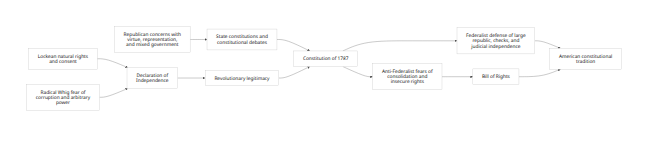
This diagram simplifies a contested historiography, but it captures the highest-confidence conclusion: the founding was a modern constitutional synthesis built from rights, republicanism, and institutional prudence rather than an act of preserving an inherited pre-liberal social order. \[16\]
Conceptual definitions and analytical framework Link to heading
For purposes of analysis, conservatism means a post-Enlightenment disposition or ideology that values inherited institutions, historical experience, gradual and organic change, and skepticism toward rationalist projects of moral or political reconstruction. The Stanford Encyclopedia emphasizes conservatism’s opposition to utopian exaggerations of reason and perfectibility, while Samuel Huntington’s classic formulation describes conservatism as the rationalization of existing institutions in terms of history, nature, God, and man. Liberalism means a family of doctrines centered on liberty, rights, toleration, consent, and limits on coercive authority. Revolutionary means the claim that people may rightfully replace a regime when it violates basic ends of government. Post-liberal refers to contemporary arguments that liberalism’s own internal logic produces atomization, privatism, inequality, and an overgrown state, and that politics should be reordered around substantive goods or communal ends. Tradition means inherited and transmitted patterns of thought and practice; in conservative usage, it is usually understood as evolving rather than frozen. \[17\]
The categories matter because the user’s grievance becomes much sharper once expressed formally. The problem is not simply that the United States contains liberal elements. The problem is that the regime’s foundational source of authority is liberal-revolutionary, whereas traditional conservatism usually derives legitimacy from inheritance, prescription, continuity, and authority accumulated over time. That is the pressure point. If the founding itself is a rupture justified by universal principles, a conservative politics built on reverence for inherited order has to either reinterpret the founding as conservative, redefine “tradition” around the post-1787 constitutional order, or reject the founding’s premises as insufficient. \[18\]
The following comparative table summarizes where the founding aligns with and diverges from conservatism.
Dimension Founding core Affinity with Affinity with Bottom-line assessment
commitments conservatism liberalism or
revolutionary
republicanism
Political Natural equality, Low Very high Strongly
legitimacy unalienable rights, liberal-revolutionary
consent of the
governed, right of
revolution
Institutional Federalism, High High Hybrid: liberal ends
design bicameralism, with conservative
separated powers, restraints
checks and balances,
judicial independence
Religion and No religious test, Medium High Liberal in law, morally
conscience disestablishmentary conservative in civic
impulse, liberty of culture
conscience, but
public emphasis on
religion and morality
Social order Slavery, coverture, High in Low in Socially hierarchical restricted franchise, practice principle but ideologically deference to property unstable and local elites
National A founded republic Low to medium High More
identity articulated through propositional/civic
principles and than
constitutional forms, traditional-national
not ancient bloodline
or established church
Reform and Revolutionary break Medium High Revolutionary in
change justified by origin, cautious in
principle, yet method
repeated warnings
about prudence and
long-standing
institutions
Link to heading
This table is synthesized from the Declaration, Constitution, Federalist Papers, Anti-Federalist debates, and major scholarship on the founding’s multiple ideological inheritances. \[19\]
The most important takeaway from the framework is that the founding is liberal and revolutionary at the level of first principles, but more conservative at the level of institutional engineering and social practice. That means the claim “there is nothing conservative about the United States” is too strong if it refers to federalism, prudence, moral preconditions for liberty, localism, and checks on democracy. But it is substantially correct if it refers to the basic source of legitimacy and to the nation’s self-understanding as a rights-bearing political project. \[20\]
Scholarly literature and contemporary critiques Link to heading
The scholarly literature clusters into a few major positions. Louis Hartz’s “liberal tradition” thesis remains foundational because it argues that America developed without a feudal past and therefore without a native conservative social class in the European sense. Hartz’s earlier APSR essay already described the distinctive American impact of the liberal idea as individualism, weak class consciousness, and the political dominance of broadly liberal assumptions. Huntington sharpened the problem from a different angle: if conservatism is an ideology of defending existing institutions, then it appears in full force only where a threatened traditional order already exists. That makes the American case structurally unusual from the outset. \[21\]
A second cluster—Bailyn and Wood above all—showed that older materialist readings underestimated the sincerity and coherence of revolutionary ideology. Bailyn argued that colonial pamphleteers genuinely feared corruption and arbitrary power through a radical Whig lens, while Wood emphasized the extent to which the Revolution carried Americans into a recognizably modern political world. The force of this scholarship is to make the founding look not like a defense of inherited hierarchy but like a major rupture in political thought and legitimacy. \[22\]
A third and now highly influential cluster rejects any simple binary between liberalism and republicanism. Appleby argued that republicanism and liberalism were not mutually exclusive enemies but overlapping and often complementary languages in the early republic. Gibson likewise argues for a “multiple traditions” approach in which the Founders integrated several streams of thought into an original synthesis. Shalhope’s treatment of the debate makes a similar point: the founding generation itself did not live inside the later academic dichotomy. This literature is important because it undercuts both simplifications at once: the founding was neither purely Lockean-liberal nor secretly conservative. It was a composite modern republic. \[23\]
On the contemporary Right, the literature splits more sharply. A foundingist defense is represented by institutions such as Heritage and Claremont. Heritage argues that American conservatives are historically justified in presenting themselves as preservers of founding ideas and that originalism is not only conservative in style but the correct way to interpret the Constitution. Claremont states openly that its mission is to restore the principles of the American founding to preeminent authority. This is the strongest coherent answer available to traditional movement conservatism: American conservatism is coherent because what it conserves is not medieval hierarchy or ancien-régime order, but a specifically American constitutional order of “ordered liberty.” \[24\]
A post-liberal and New Right critique takes the opposite path. Patrick Deneen argues that liberalism has failed not because it betrayed itself, but because it fulfilled its own internal logic; Sohrab Ahmari argues that American conservatism failed through its pursuit of “unrestrained liberty”; Adrian Vermeule says conservative originalism and progressive living constitutionalism are both “exhausted” and should yield to a common-good constitutionalism; and the National Conservatism statement places nation, family, religion, and civilizational continuity at the center of political renewal. Internal right-wing criticism confirms the user’s central grievance: a large part of the Right now believes that conserving the liberal order is no longer enough, or is itself the problem. \[25\]
At the same time, even these post-liberal critiques reveal a second-order tension. Claremont critic Charles Kesler faults National Conservatism for downplaying the American regime’s natural-rights and constitutional identity and for mixing American nationalism with more generic tradition-centered nationalism. That dispute is highly revealing. It is not a marginal quarrel. It is a fight over whether American conservatism is defined by the Declaration and Constitution or by a broader politics of authority, religion, family, and nation that can no longer be fully justified by the founding’s propositions. \[26\]
A concise map of the literature looks like this:
School or tendency Representative Core claim Implication for works and the user’s thesis institutions
Liberal tradition Hartz America is Strong support
structurally liberal
because it lacked a
feudal-conservative
inheritance
Revolutionary-ideological Bailyn, Wood The founding was Strong support genuinely ideological and transformative
Multiple traditions Appleby, Gibson, Founders fused Supports a synthesis Shalhope, Banning liberal and moderated version tradition republican languages
Foundingist conservatism Heritage, Conservatism is Rebuttal to the
Claremont, coherent if it strongest version
originalists conserves American of the critique
constitutional
ordered liberty
Post-liberal / national Deneen, Ahmari, Liberalism and Confirms the
conservative Vermeule, NatCon fusionism failed; the critique from
right needs a more within the Right
substantive
common-good politics
Link to heading
This survey is based on the cited scholarship and contemporary institutional statements; it shows that the user’s critique tracks a real divide in both historiography and present-day conservative thought. \[27\]
Case studies in modern conservatism Link to heading
Fusionism and Reaganism Link to heading
Postwar movement conservatism solved the American problem by fusing classical liberal commitments to free markets and limited government with traditionalist commitments to virtue, religion, and anti-communism. National Affairs summarizes fusionism as the view that libertarian individualism and virtue-oriented traditionalism are complementary rather than mutually exclusive, and Reagan’s 1981 CPAC speech celebrated the conservative movement born around National Review as a force that would stand “athwart the course of history yelling, ‘Stop!’” This model was enormously successful politically, but philosophically it only works if conservatism is willing to conserve a basically liberal constitutional order and then supply private moral content around it. \[28\]
The user’s grievance lands hardest here. Fusionism made peace with the founding by effectively redefining American conservatism as the defense of liberty first, with virtue preserved mostly through family, church, market restraint, and anti-communist civic culture. Its critics now argue that this bargain preserved procedural freedom while surrendering social authority and cultural cohesion. Ahmari’s charge that American conservatism failed through “unrestrained liberty” is in large part an indictment of fusionism’s dependence on liberal premises. \[29\]
Tea Party constitutionalism, originalism, and Dobbs Link to heading
The Tea Party revived a strongly anti-statist and constitutionalist version of American conservatism. Pew found that Tea Party backers overwhelmingly identified as conservative, distrusted the federal government, favored cutting federal programs, and viewed Washington as overreaching into state and local matters. This is classic “constitutional conservatism”: the Right presents itself as restoring limited government by returning to the founding framework. Heritage’s originalism essay gives the theory its juridical expression, explicitly arguing that American conservatism needs originalism. \[30\]
But the legal side of the story reveals an instability. In Dobbs, the Supreme Court majority justified its holding by arguing that abortion is not “deeply rooted in the Nation’s history and traditions.” That is not the language of the Declaration’s universal rights; it is the language of inherited tradition and historical pedigree. In practice, then, conservative constitutionalism oscillates between two legitimating grammars: the founding’s rights-based universalism and a more historically sedimented appeal to national tradition. The case study shows that modern conservative jurisprudence often relies on both, without clearly deciding which has priority. \[31\]
National conservatism, Christian nationalism, and post-liberal law Link to heading
National conservatism and the broader post-liberal turn make the tension impossible to ignore. The National Conservatism statement calls for restoring patriotism, family, religion, and national self-government, while also defending a strong but limited state and federalist decentralization. PRRI reports that in 2024, about 30 percent of Americans were either Christian nationalism adherents or sympathizers and that 53 percent of Republicans fell into those two categories combined. This is not simply a restatement of founding constitutionalism. It is a more substantive politics of civilizational and moral restoration. \[32\]
The legal and theoretical side of the same movement is explicit. Vermeule proposes common-good constitutionalism as an alternative to both conservative originalism and progressive living constitutionalism, arguing that American law from the founding was embedded in a broader classical legal tradition ordered to justice, peace, prosperity, and morality. Deneen argues for replacing the liberal elite and the ideology that empowered them. This is no longer “conservatism” in the sense of simply conserving the constitutional liberal founding. It is an attempt to surpass the founding’s dominant grammar while often retaining its institutions. That is precisely why internal critics on the right accuse national conservatives of moving away from America’s natural-rights constitutional identity. \[33\]
Implications for conservative strategy Link to heading
If conservatives want intellectual coherence, the first recommendation is conceptual honesty: stop calling the Founders “conservatives” without qualification. The more accurate description is liberal-republican revolutionaries who built a cautious constitutional order. That shift in vocabulary would clarify rather than weaken conservative argument. It would allow the Right to say, truthfully, that the American regime was founded on modern principles of rights and consent, while also insisting that those principles were institutionalized through prudence, federalism, religion-friendly civil society, and checks on power. \[34\]
The second recommendation is strategic differentiation. There are really three coherent routes available. One route is founding constitutional conservatism: conserve ordered liberty, originalism, federalism, local self-government, religious liberty, and the constitutional separation of powers. A second route is American Burkean institutionalism: conserve the accumulated American tradition of associations, localism, common-law habits, family authority, and civic restraint, while admitting that the founding was a modern political break rather than a traditional one. A third route is open post-liberal revisionism: argue candidly that the founding’s liberal premises are insufficient and that a more substantive common-good politics is necessary. What is not coherent is a politics that uses founding rhetoric when it is convenient and post-liberal premises when rights language becomes inconvenient. \[35\]
The third recommendation concerns political emphasis. The most viable overlap between the founding and conservative prudence lies not in pretending the founding was pre-liberal, but in recovering the domains where the founding already distrusted concentrated power and abstract moral engineering: federalism, separated powers, representation, local self-government, voluntary religion, and civic virtue. Madison’s defense of checks and balances, the Anti-Federalist warning against consolidation, and Washington’s insistence on religion and morality as supports of political prosperity all point toward a conservative politics of restraint and formation rather than toward a purely libertarian or purely statist project. \[36\]
The fourth recommendation is rhetorical. Conservatives should abandon mythic claims that every present preference is latent in 1776 or 1787. That style of argument invites historical overreach, weakens credibility, and guarantees internal contradiction. A stronger style would distinguish among founding principle, constitutional development, and later American tradition. Once those layers are separated, conservative argument becomes more accurate and more resilient. \[37\]
Limitations and open questions Link to heading
Two important limitations remain. First, the founding was not one thing. There is a meaningful difference between the world of 1776, the settlement of 1787, and the rights amendments of 1791. Treating “the founding” as a single frozen moment can obscure real differences between revolutionary justification, constitutional design, and later political development. Second, most of the evidence emphasized here comes from elite political texts and the most influential scholarly works about them. That is appropriate for a report about constitutional ideology, but it leaves aside popular political religion, local practice, and the many state-level variations that complicated the early republic. \[38\]
Several open questions follow. Can a post-liberal Right revise liberal institutions without ceasing to be constitutionalist? Can a foundingist Right defend universal natural-rights language while still appealing to thick moral and religious traditions? And if American conservatism is really the conservation of a liberal constitutional order plus inherited civic habits, does its true object of conservation lie more in the nineteenth and twentieth centuries than in 1776 itself? Those are not peripheral questions. They are the questions that now divide the Right. \[39\]
Bibliography Link to heading
Primary sources Link to heading
Adams, John. Thoughts on Government, Applicable to the Present State of the American Colonies. 1776.
Brutus. Essay No. 1. 1787.
Hamilton, Alexander. Federalist No. 78. 1788.
Jefferson, Thomas. Declaration of Independence. 1776.
Jefferson, Thomas. Virginia Statute for Religious Freedom. 1786.
Madison, James. Federalist No. 10. 1787.
Madison, James. Federalist No. 39. 1788.
Madison, James. Federalist No. 51. 1788.
Madison, James. Memorial and Remonstrance Against Religious Assessments. 1785.
The Federal Farmer. Letters to the Republican. 1787–1788.
United States. Constitution of the United States. 1787.
Washington, George. Farewell Address. 1796.
Selected scholarship and contemporary works Link to heading
Ahmari, Sohrab. “American Conservatism Is a Failure.” The American Conservative, 2020.
Appleby, Joyce. Liberalism and Republicanism in the Historical Imagination. Harvard University Press, 1992.
Bailyn, Bernard. The Ideological Origins of the American Revolution. Harvard University Press, 1967; enlarged ed., 1992.
Deneen, Patrick J. Why Liberalism Failed. Yale University Press, 2018.
Deneen, Patrick J. Regime Change: Toward a Postliberal Future. Sentinel, 2023.
Gibson, Alan. “Ancients, Moderns and Americans: The Republicanism-Liberalism Debate Revisited.” History of Political Thought 21, no. 2, 2000.
Hartz, Louis. The Liberal Tradition in America. Harcourt, Brace, 1955.
Hartz, Louis. “The Whig Tradition in America and Europe.” American Political Science Review 46, no. 4, 1952.
Hazony, Yoram. “Conservative Democracy.” First Things, 2019.
Huntington, Samuel P. “Conservatism as an Ideology.” American Political Science Review 51, no. 2, 1957.
Kirk, Russell. The Conservative Mind. Henry Regnery, 1953.
Nash, George H. The Conservative Intellectual Movement in America Since 1945. Basic Books, 1976; later editions.
Rodgers, Daniel T. “Republicanism: The Career of a Concept.” Journal of American History 79, no. 1, 1992.
Vermeule, Adrian. Common Good Constitutionalism. Polity, 2022.
Whittington, Keith E. “Is Originalism Too Conservative?” 1991.
Wood, Gordon S. The Creation of the American Republic, 1776–1787. University of North Carolina Press, 1969; 1998 ed.
Wood, Gordon S. The Radicalism of the American Revolution. Knopf, 1992.
\[1\] \[2\] \[4\] \[10\] \[18\] \[19\] \[20\] \[34\] \[38\] https://www.archives.gov/founding-docs/declaration-transcript
https://www.archives.gov/founding-docs/declaration-transcript
\[3\] \[22\] https://books.google.com/books/about/The_Ideological_Origins_of_the_American.html?id=M2ufnU-PHH0C
https://books.google.com/books/about/The_Ideological_Origins_of_the_American.html?id=M2ufnU-PHH0C
\[5\] \[24\] https://www.heritage.org/american-history/report/why-the-american-founding-matters-american-conservatism
\[6\] \[35\] https://www.heritage.org/the-constitution/report/originalism-and-conservatism-american-story
https://www.heritage.org/the-constitution/report/originalism-and-conservatism-american-story
\[7\] \[17\] https://plato.stanford.edu/entries/conservatism/
https://plato.stanford.edu/entries/conservatism/
\[8\] \[11\] \[16\] https://www.loc.gov/exhibits/creating-the-united-states/interactives/declaration-of-independence/consent/documents.html
\[9\] \[37\] https://philpapers.org/rec/GIBAMA
https://philpapers.org/rec/GIBAMA
\[12\] https://www.jstor.org/stable/10.5149/9780807899816_wood
https://www.jstor.org/stable/10.5149/9780807899816_wood
\[13\] https://www.archives.gov/founding-docs/constitution-transcript
https://www.archives.gov/founding-docs/constitution-transcript
\[14\] https://constitutioncenter.org/the-constitution/historic-document-library/detail/brutus-essay-no-1
https://constitutioncenter.org/the-constitution/historic-document-library/detail/brutus-essay-no-1
\[15\] https://constitutioncenter.org/the-constitution/historic-document-library/detail/james-madison-memorial-and-remonstrance-against-religious-assessments-1785
\[21\] \[27\] https://www.cambridge.org/core/journals/american-political-science-review/article/whig-tradition-in-america-and-europe/132922919816F7BAB549682EB75ED904
\[23\] https://books.google.com/books/about/Liberalism_and_Republicanism_in_the_Hist.html?id=83HlqTJjLcgC
https://books.google.com/books/about/Liberalism_and_Republicanism_in_the_Hist.html?id=83HlqTJjLcgC
\[25\] \[39\] https://yalebooks.yale.edu/book/9780300231878/why-liberalism-failed/
https://yalebooks.yale.edu/book/9780300231878/why-liberalism-failed/
\[26\] https://americanmind.org/features/national-conservatism-vs-american-conservatism/
https://americanmind.org/features/national-conservatism-vs-american-conservatism/
\[28\] https://nationalaffairs.com/publications/detail/a-family-focused-fusionism
https://nationalaffairs.com/publications/detail/a-family-focused-fusionism
\[29\] https://www.theamericanconservative.com/american-conservatism-is-a-failure/
https://www.theamericanconservative.com/american-conservatism-is-a-failure/
\[30\] https://www.pewresearch.org/politics/2010/04/18/section-6-tea-party-and-views-of-government-overreach/
\[31\] https://www.supremecourt.gov/opinions/21pdf/19-1392_6j37.pdf
https://www.supremecourt.gov/opinions/21pdf/19-1392_6j37.pdf
\[32\] https://nationalconservatism.org/national-conservatism-a-statement-of-principles/
https://nationalconservatism.org/national-conservatism-a-statement-of-principles/
\[33\] https://hls.harvard.edu/bibliography/common-good-constitutionalism/
https://hls.harvard.edu/bibliography/common-good-constitutionalism/