Introduction: Upgrading an unpaved dirt or gravel road into a long-lasting, high-speed highway involves a multi-phase engineering process. It requires improving the foundation (subgrade), adding structured base layers with proper drainage, selecting a suitable pavement surface (asphalt or concrete), ensuring rigorous construction quality control, and planning for ongoing maintenance. Each design detail – from subgrade stabilization and layer thickness to surface texture and drainage – plays a critical role in the finished road’s ride quality, load capacity, safety, noise level, and maintenance needs. Furthermore, modern best practices are informed by historic road-building milestones (from 19th-century Macadam roads to the mid-20th-century Autobahn and Interstate systems, and recent innovations like porous asphalt). Below, we detail the five key phases of road upgrading, the design features that drive performance, and the lessons learned from landmark projects in road engineering history.
Phase 1: Site Investigation & Subgrade Engineering Link to heading
Before paving, engineers thoroughly investigate the existing roadbed soil and terrain. Geotechnical tests (e.g. California Bearing Ratio (CBR) or resilient modulus measurements) are conducted in situ or in the lab to assess the strength and stiffness of the subgrade soil\[1\]\[2\]. The resilient modulus (M<sub>R</sub>) is especially important, as it quantifies the soil’s ability to elastically support loads and is the primary subgrade property used in pavement design\[1\]. Based on these tests, engineers determine if the native subgrade can support highway traffic or if it needs improvement.
Subgrade Stabilization: If the existing soil is weak (e.g. high plastic clay or expansive soil), improvement is needed to avoid premature pavement failure\[2\]. Common approaches include mechanical stabilization (compacting and adding gravel or geosynthetics) or chemical stabilization (mixing in additives like lime, cement, or fly ash). For example, a case study on Ethiopia’s Modjo–Hawassa Highway showed that mixing 4–8% quicklime into an expansive clay subgrade raised its CBR (strength) by ~57% on average and reduced water swelling by over 90%\[3\]. Such lime or cement stabilization chemically alters clay minerals, lowering plasticity and greatly increasing load-bearing capacity. In other cases, geotextile fabric may be laid on the subgrade to separate it from the base gravel and prevent intermixing (especially if the subgrade is silty and prone to pumping). The end goal is a uniform, non-yielding subgrade with sufficient stiffness (often M<sub>R</sub> > ~30–50 MPa, or CBR > 8–10 for highways) so that it can carry traffic loads without excessive deformation\[1\]\[4\].
Topography and Drainage: The site investigation also surveys the road’s alignment, grading, and drainage patterns. Engineers ensure there is adequate roadbed drainage, as water is the enemy of pavement longevity. If needed, they design drainage improvements like side ditches, culverts, or subsurface drains to keep the subgrade dry. In cold climates, frost-susceptible soils may require special mitigation (e.g. added insulation or removal and replacement with non-frost material) so that freeze-thaw cycles do not cause heaving. All these subgrade preparations are foundational: as a common maxim states, the pavement is only as good as what lies beneath it. A well-compacted, well-drained subgrade sets the stage for the layers above.
Phase 2: Granular Base & Drainage Layer Link to heading
Once the subgrade is stabilized and graded to the proper elevation, the next step is constructing the base layers. The base is typically a thick layer of crushed stone or gravel that sits on the subgrade, providing additional strength and helping distribute loads. On a project converting a gravel road, the existing gravel surface can often be reused as part of the base – it is re-graded, supplemented with new aggregate if needed, and thoroughly compacted\[5\]. The base layer performs several functions: it adds structural capacity, prevents excessive stress on the subgrade, and provides a stable platform for paving.
Materials and Gradation: A high-quality base uses well-graded aggregate – a mix of stone sizes (from coarse down to fine) that compacts into a dense, tight matrix. According to the FHWA’s Gravel Roads Construction & Maintenance Guide, “good” base or surface gravel should include a balance of fines and coarse rock: ideally about 4–15% of the material passing the #200 sieve (to provide binder and stability) and a plasticity index of around 3–12 in those fines\[5\]. This ensures the gravel has enough clay/silt to bind the stones, but not so much that it becomes muddy or weak. Well-graded base gravel that is compacted near optimum moisture will form a solid layer capable of supporting paving equipment and traffic\[5\].
Layer Thickness and Compaction: The required base thickness depends on expected traffic loading and subgrade strength. For heavy highway traffic on a previously unpaved road, base courses might be 6 to 12 inches (15–30 cm) or more, often placed in two or more lifts. Each lift is spread and then compacted to a target density (typically ≥95% of maximum dry density per standard Proctor, AASHTO T99) using rollers. Thorough compaction is critical – any voids or loose areas in the base can lead to differential settlement and later pavement cracking. If the existing gravel layer is thin, additional crushed rock is brought in to build up the base thickness. During compaction, the base is shaped to have a proper crown (cross-slope) for drainage. Gravel roads usually have a crown of about 4% (1/2 inch of drop per foot to each side) to shed water, whereas paved surfaces use a milder crown around 2%\[6\]. This crown ensures rainwater will flow off to the shoulders and into ditches, rather than ponding on the roadway or saturating the base. Lastly, engineers may incorporate a drainage layer within or beneath the base – for instance, a layer of open-graded stone or a geocomposite drain – to quickly remove water that infiltrates, protecting the subgrade from softening. In sum, Phase 2 yields a strong, compacted, free-draining foundation of aggregate on which the actual pavement will be built.
Phase 3: Surface Selection & Mix Design Link to heading
With a sound base in place, attention turns to the pavement surface – the hard layer that directly carries vehicle loads and provides a smooth, safe driving interface. Engineers must choose between a flexible pavement (typically Hot Mix Asphalt) or a rigid pavement (Portland cement concrete), or sometimes a staged combination. Key considerations include traffic volume and weight, climate, available materials, and life-cycle cost. Modern highways use a variety of advanced mix designs (asphalt mixes like dense-graded HMA, Stone Mastic Asphalt, open-graded friction courses, etc., or various concrete formulations) to meet performance goals.
Asphalt Surfacing Options: A common upgrade path for rural roads is to apply layers of Hot Mix Asphalt (HMA) over the prepared base. Standard HMA consists of graded aggregates bound with asphalt cement (bitumen), designed to be flexible and accommodate minor subgrade movement. Different asphalt mix types can be selected for specific needs. For example, Stone Matrix Asphalt (SMA) is a gap-graded mix with a high stone content and asphalt-rich mortar that maximizes rutting resistance and durability – it was developed in Europe for heavily trafficked roads and is known to resist deformation under heavy truck loads\[7\]. On the other end, an Open-Graded Friction Course (OGFC) (also called porous asphalt) is a surface layer with high air voids (~15–20%) that allows water to drain through, greatly improving wet-weather traction and reducing splash and spray\[8\]\[9\]. OGFC surfaces are valued for safety (less hydroplaning) and noise reduction – studies have found they can cut tire/road noise by about 3–5 decibels compared to conventional dense asphalt\[10\], though they require periodic maintenance as the voids can clog and the open mix is somewhat less durable over time\[11\]\[12\]. For lower-volume roads, or as an interim step, agencies sometimes use a chip seal (surface treatment) instead of full asphalt paving. A chip seal involves spraying a thin layer of asphalt emulsion and immediately spreading a layer of small stone chips, which stick to form a rudimentary paved surface once rolled. It’s essentially a “seal coat” over the gravel – not structural, but it provides a waterproof, low-dust riding surface. In fact, some definitions of “paved road” include even a light chip seal, whereas others reserve “paved” for a substantial asphalt layer\[13\]. Many local jurisdictions treat chip seals as the first step toward full paving – for instance, a town might chip-seal a graded gravel road to stabilize it and then later add 2–4 inches of HMA when funding allows\[14\]. This staged approach protects the base and subgrade in the meantime\[15\].
Concrete Surfacing Option: Alternatively, the road can be surfaced with Portland Cement Concrete (PCC) slabs. Concrete pavements (rigid pavements) are known for their longevity and low maintenance – a well-built concrete highway can last 30–40 years before needing major rehabilitation – but they involve higher initial cost and require careful joint design to manage cracking. In the early 20th century, some gravel roads were upgraded by placing a PCC slab directly over the compacted earth (early concrete roads). Today’s practice for high-quality concrete highways is to have a prepared base (sometimes a stabilized base) under the concrete for uniform support\[16\]\[17\]. Concrete might be chosen for very high truck traffic routes or where local materials (cement, aggregate) favor it. For instance, the German Autobahns of the 1930s were largely built with concrete surfaces\[18\], and many segments of the U.S. Interstate system were built in concrete based on life-cycle cost considerations. If concrete is used in a dirt-to-paved upgrade, one must ensure adequate thickness (often 8 inches or more for highways) and include expansion/contraction joints or continuous reinforcement to control cracking.
Mix Design and Testing: Regardless of surface type, engineers perform proper mix design. For asphalt, this means selecting an appropriate asphalt binder grade (with modifiers if needed for temperature susceptibility or rut resistance) and aggregate gradation, then verifying the design via laboratory compaction tests (Marshall or Superpave gyratory compactor) to meet voids and stability criteria\[7\]. For concrete, mix design involves choosing a suitable cement type, water-cement ratio, admixtures (perhaps air entrainment for freeze-thaw durability), and aggregate, then testing for strength and workability. Modern paving also considers innovative additives: for example, polymer-modified asphalts for higher elasticity, fibers in SMA mixes to reduce draindown, or even experimental self-healing additives (like steel wool fibers in porous asphalt that can be inductively heated to heal cracks\[19\]). The chosen mix and surfacing strategy in Phase 3 thus tailors the new road’s surface to the expected conditions, whether prioritizing heavy-load resistance, smooth quiet ride, or low initial cost.
Phase 4: Construction & Quality Control Link to heading
With design and materials ready, the road upgrade moves into construction. Here, meticulous quality control (QC) is vital to ensure the as-built pavement matches the design specifications. Even a well-designed pavement can fail early if poor construction practices lead to weak spots or defects. Key QC activities occur layer by layer during the build:
Earthwork and Base QC: The subgrade should be at the correct moisture content and density before base placement. Field technicians often perform density tests on the compacted subgrade and base (using nuclear gauges or sand cone tests) to verify they meet the minimum compaction (often 95% of Proctor density) and proper moisture. If any area is below spec, the contractor must rework and recompact it. Additionally, the thickness of each layer is checked (e.g. probing or using level surveys) to ensure the design thickness is achieved – insufficient base thickness in any spot is corrected by adding material. These steps prevent weak zones that could later settle or rut.
Paving Operations: Paving with asphalt typically requires the HMA to be laid and compacted while hot (around 120–150°C for conventional hot-mix). Thus, temperature control and timing are monitored – the mix must arrive at the site at the right temp, and rollers should compact it before it cools below a certain threshold for proper density. Inspectors check that the asphalt mat’s density after rolling meets target (often around 92–97% of theoretical maximum density) so that there are no excessive air voids which could lead to rutting or moisture damage. For concrete paving, QC involves verifying the mix consistency (slump, air content) and that curing procedures are followed (to prevent the slab from drying out too fast and cracking). In all cases, weather conditions are heeded: for instance, asphalt should not be laid in heavy rain or on overly cold days, and concrete may need thermal protection if poured in freezing conditions.
Smoothness and Alignment: A hallmark of a high-quality highway is a smooth ride, so new pavements are tested for smoothness. Agencies commonly use a profilograph or laser profiler to measure the initial roughness (quantified as International Roughness Index, IRI). Modern specifications often require the contractor to achieve an IRI below a certain value (e.g. new interstates often <65 inches/mile IRI)\[20\], or else grind down bumps. Smoothness matters because it affects driver comfort and also long-term performance (rough roads incur dynamic wheel loads that can accelerate deterioration). To check local smoothness, a straightedge test (e.g. no more than 1/8 inch deviation under a 10-ft straightedge) may be used on the finished surface\[21\]\[22\]. Alignment (grades, superelevation on curves, lane width) is also checked against design – for example, on curves the superelevation (banking) must be correctly built to allow safe high-speed travel. Highways have specific superelevation rates depending on design speed (e.g. up to 6–8% tilt on sharper curves); constructors use surveying equipment to achieve these transverse slopes as per plans.
Thickness and Material Tests: Cores or drilled samples of the pavement may be taken to confirm the layer thickness of asphalt or concrete matches the design and that there are no significant segregation or void issues. If it’s a concrete road, cores can also be tested for compressive strength at 28 days to ensure the concrete has gained the required strength. Asphalt cores might be tested for density and thickness. Additionally, for asphalt, QC includes checking that the asphalt binder content and aggregate gradation of the produced mix are within tolerances (this is usually done via sampling trucks and running lab tests). All these measures – density tests, smoothness measurements, thickness verifications, etc. – form a comprehensive QC program so that when the road opens, it is built to last. In practice, a well-executed dirt-to-pavement project might even allow controlled traffic on the compacted base or an initial chip seal (to keep dust down) while final surface curing or staging is completed\[14\].
Phase 5: Maintenance & Rehabilitation Planning Link to heading
Even after a gravel road is transformed into a paved highway, the work isn’t “one and done” – ongoing maintenance is crucial to preserving performance over the road’s life cycle. Engineers implement a pavement management plan to monitor the new road and schedule timely interventions:
Routine Maintenance: This includes activities like sealing small cracks, repairing isolated potholes, and cleaning drains. For asphalt surfaces, a preventive measure is periodic seal coats (renewing the chip seal or fog seal every 5–7 years) to rejuvenate the surface and keep water out\[23\]. Keeping the shoulders graded and the ditches clear is also vital so that water continues to drain off the pavement edges. For concrete, routine maintenance might involve sealing joints and cracks to prevent water infiltration and reactive distress. Skid resistance is monitored – if the surface becomes polished and slippery, agencies may schedule a surface treatment (like micro-surfacing or diamond grinding for concrete) to restore texture and grip.
Performance Monitoring: The pavement is periodically evaluated for key indicators of deterioration, such as roughness (IRI), rut depth (in asphalt), surface distresses (cracking, raveling), and friction coefficient. These data feed into a Life-Cycle Cost Analysis (LCCA) to determine the optimal timing for rehabilitation. For example, if an asphalt road’s roughness and cracking are increasing faster than expected, an engineer might advance the plan to overlay it with a fresh layer of HMA after, say, 12–15 years rather than 20. The goal is to apply relatively minor rehabilitations (like thin overlays or surface milling and repaving) at the right time to avoid the road ever degrading to the point of needing a major reconstruction. A well-timed 1-2 inch asphalt overlay can extend pavement life and delay heavier repairs. Similarly, concrete pavements might get diamond grinding (to smooth bumps and improve friction) and partial-depth slab repairs at mid-life, rather than waiting for extensive damage.
Innovations in Longevity: Research is ongoing into making pavements last longer with fewer interventions. One cutting-edge example is self-healing asphalt being studied in the Netherlands – porous asphalt mixes with steel fiber additives can be induction-heated to heal micro-cracks, potentially doubling service life\[24\]. The Dutch have widely used two-layer porous asphalt on busy motorways for noise reduction and are experimenting with these self-healing techniques to address the primary durability issue of porous mixes (raveling of aggregates over time)\[11\]\[25\]. Early results show promise in significantly reducing maintenance costs if induction healing is applied every few years\[24\]. Additionally, the use of recycled materials contributes to sustainable maintenance: reclaimed asphalt pavement (RAP) from old surfaces can be milled and reused in new asphalt mixes, conserving materials and energy\[4\]. Many highway agencies now routinely include 20-40% RAP in new asphalt layers, and use warm-mix asphalt technologies to lower production temperatures (e.g. mixing at ~100°C instead of 150°C), which cuts fuel consumption and emissions\[26\]. These sustainable practices help reduce the life-cycle environmental footprint while keeping the road in top condition.
By following a structured approach through these five phases – from thorough subgrade prep to vigilant long-term maintenance – a former dirt track can be successfully transformed into a durable, high-quality highway.
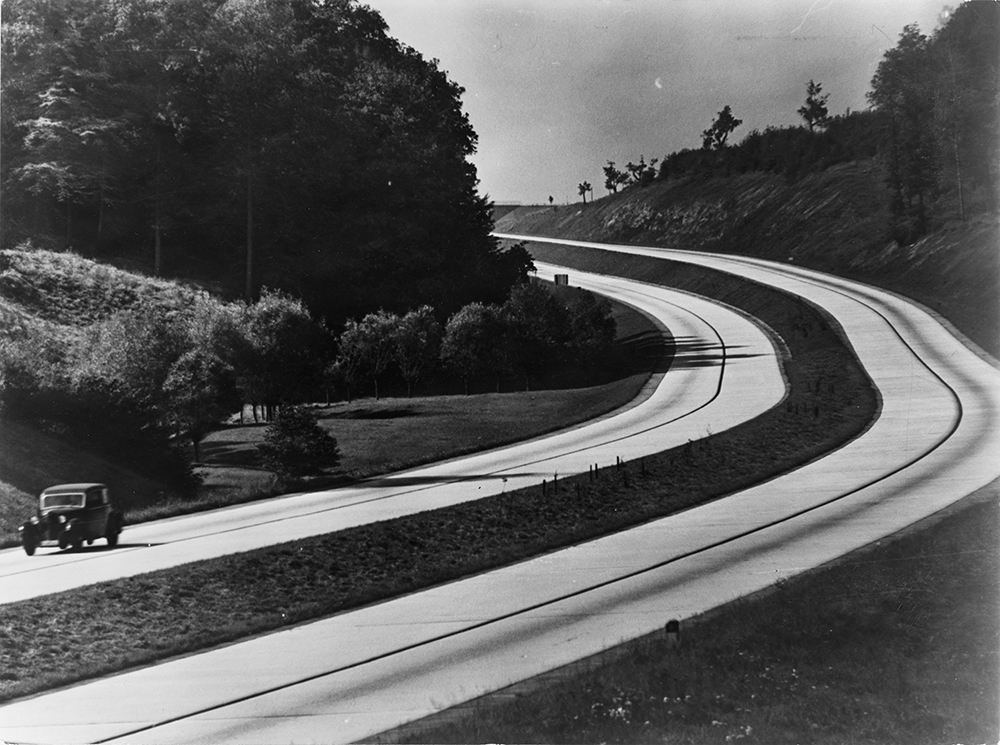 {width=“5.833333333333333in” height=“4.345833333333333in”}
An early German Autobahn (c.1936) with a concrete surface and broad sweeping curves. High-speed roads like this influenced modern highway design – engineers limited grades to ~8% and curve radii to minimum 600 m for safety at speed\[27\]. The Autobahnen were mostly built in concrete (about 80% of the network by 1941)\[18\], and many segments remain in service decades later.
Design Details that Drive Performance Link to heading
Upgrading a road is not just about following steps, but also about getting the details right. The following design elements are especially influential on a paved road’s performance in terms of ride quality, load capacity, safety, noise, and maintenance costs:
Subgrade Strength and Uniformity: As noted, the subgrade’s resilient modulus or CBR has a direct impact on how thick the pavement must be and how it will perform. A stronger subgrade (through natural soil or stabilization) increases load capacity – it can support heavier trucks with less risk of rutting or bending. Uniform subgrade support also improves ride quality by preventing differential settling (which would cause bumps or dips). Investing in subgrade improvement (e.g. lime stabilization) can greatly reduce future maintenance: for instance, by eliminating soft spots that would later cause potholes or cracks. Conversely, if a road is paved over a patchy, weak subgrade, it may initially feel smooth but soon develop roughness and require frequent patching – a false economy. Modern mechanistic-empirical design explicitly accounts for subgrade modulus and even seasonal variations (frozen vs. wet conditions) to ensure performance targets are met\[1\]\[28\].
Layer Thickness (Structural Capacity): The pavement’s structural design (thickness of base, asphalt, and/or concrete) is a primary driver of load-bearing capacity and longevity. Adequate thickness prevents excessive flexing under wheel loads. Empirical design methods, like the AASHTO 1993 guide, established relationships between thickness and traffic loads using findings from the AASHO Road Test\[29\]. In that 1958–60 test, 836 pavement sections of varying thicknesses were trafficked to failure, showing that, for example, 4 inches of asphalt can carry roughly 10 times the traffic of 2 inches on the same base\[30\]. This is why the Asphalt Institute strongly recommends a minimum of 4 inches of asphalt (or 3 inches of asphalt over a strong base) even on low-volume roads\[31\] – thinner “pavements” (like a 1–2″ chip seal or thin mat) simply do not support loads well and function mainly as a wearing surface\[13\]\[23\]. For highways, thicker structures (e.g. a foot of granular base and 5–8″ of asphalt, or 9″+ concrete) cost more initially but usually pay off in lower maintenance. Insufficient thickness leads to early fatigue cracking, which degrades ride quality and requires expensive rehabilitation. Thus, optimizing thickness via either empirical charts or newer mechanistic-empirical design software is crucial to meet the desired design life (often 20+ years for primary highways) without premature failure.
Surface Texture and Friction: The road’s top layer characteristics directly affect safety (skid resistance, stopping distance) and noise (tire/pavement interaction noise). A texture that is too smooth can become slick in wet weather. That’s why even new concrete highways are often textured (tined or ground) and new asphalt mixes include surface aggregate with high polish resistance. Designs like open-graded friction course asphalt explicitly maximize surface friction by draining water – this greatly reduces wet crashes (hydroplaning is curtailed)\[9\]\[12\]. The trade-off is that certain high-friction surfaces (like OGFC or tined concrete) tend to be quieter as well – OGFC’s voids reduce the tire noise by a few decibels\[10\], which is noticeable to the driver and community (a 3 dB reduction is roughly a 50% decrease in sound energy). Conversely, longitudinal turf drag concrete or very smooth asphalt can be quiet but one must ensure they still provide enough macrotexture for skid resistance in rain. Engineers often balance these factors by specifying a texture depth (e.g. via sand patch test for asphalt or groove spacing for concrete) that yields good friction. In urban or sensitive areas, noise considerations might drive the choice of pavement type – e.g. some Dutch highways use two-lift porous asphalt specifically to mitigate noise near residential zones\[11\]. Ultimately, surface design that maintains high friction over time (with maintenance like re-texturing when needed) saves lives and also influences public perception (a noisy, screechy road vs. a quiet one can affect community satisfaction and property values).
Drainage and Frost Protection: A well-known adage in pavement engineering is “Drainage, Drainage, Drainage.” Water in the pavement structure weakens the subgrade and base, causes differential heaving, and accelerates damage (especially under traffic as water gets pumped). Thus, design details like maintaining that 2–4% cross slope, sealing cracks to prevent water ingress, and providing edge drains or outlet channels for water are all critical. Poor drainage shows up as increased maintenance costs – for instance, water entering the base leads to spring thaws where sections become soft and rutted, requiring patching or load restrictions. Roads in cold climates also incorporate frost-resistant design: either using non-frost-susceptible base material or sufficient thickness so that frost heave is uniform. If not, the road may develop seasonal roughness (frost boils and heaves) that degrade ride quality and structure. In summary, investing in drainage features (ditches, drains, impermeable membranes, etc.) can dramatically reduce lifetime rehabilitation needs – it is often cited that $1 spent on drainage can save $3–5 in future repairs due to moisture damage.
Ride Smoothness (Initial and Retained): Ride quality (usually measured by IRI or PSI – Present Serviceability Index) is a key performance metric for users. The design influences this in two ways: initial construction smoothness (as discussed, achieved via good practices and QC) and the ability to retain smoothness over time. The latter is tied to structural adequacy and joint or crack design. Highways that start smooth but are under-designed can quickly get rough as cracks and ruts develop under traffic. For concrete, poorly designed joints or inadequate load transfer can lead to faulting (step bumps at joints). Thus, features like dowel bars in concrete joints or stabilized bases to prevent settlements are included to preserve smoothness. For asphalt, using a mix that is resistant to rutting (like an SMA for heavy traffic) and properly thick so it doesn’t fatigue helps keep the ride smooth longer. Studies from the AASHO Road Test showed that as pavements deteriorate (crack, rut), the PSI drops – and user costs (for vehicle repairs, etc.) rise exponentially\[32\]\[33\]. Hence, highway agencies aim to design for a high initial smoothness and slow deterioration. Smoothness is not just a luxury; it lowers vehicle operating costs and delays the point at which rehabilitation is needed.
Material Durability and Sustainability: Finally, the choice of materials affects both performance and long-term economics. Using better quality aggregates (strong, cubic, crushed rock) in asphalt or base can increase pavement life by resisting abrasion and rutting. Modified binders (like polymer-modified asphalts) can improve resistance to temperature extremes – reducing thermal cracking in cold weather and rutting in hot weather. These enhancements may add cost upfront but extend the interval before maintenance is required. Additionally, incorporating recycled materials smartly can maintain performance while cutting cost and environmental impact. Highways routinely reuse Reclaimed Asphalt Pavement (RAP); this not only saves on virgin binder and aggregate, but also conserves energy and landfill space\[4\]\[34\]. RAP can perform as well as virgin mix if processed and fractionated properly, and its use (often 20%+ in new mixes) has become standard practice without sacrificing quality\[4\]\[35\]. Similarly, Recycled Concrete Aggregate (RCA) from old concrete can be used in base layers or even new concrete, and industrial byproducts like slag or fly ash can enhance mixes (fly ash in concrete improves durability, slag in asphalt can improve skid resistance). From a sustainability angle, warm-mix asphalt (WMA) technologies allow mixing and laying asphalt at lower temperatures, which reduces fuel usage and emissions without harming pavement quality\[26\]. Many states have adopted WMA for a large percentage of projects – benefiting workers (lower fume exposure) and the environment, all while producing pavements with performance equal to or better than hot-mix. In summary, attention to material selection and innovative reuse can yield a pavement that not only performs well but does so at a lower life-cycle cost and carbon footprint – increasingly important performance metrics in modern infrastructure.
Lessons from Historical Road Projects Link to heading
Modern roadbuilding stands on the shoulders of past engineering successes and failures. Several landmark projects in history have shaped today’s best practices, offering valuable lessons for present-day engineers upgrading roads:
Macadam Roads (1800s): John Loudon McAdam’s innovation around 1820 revolutionized road construction by focusing on layered, compacted stone with good drainage. Prior roads often had large pavers or were basically dirt; McAdam showed that a 8–10 inch thickness of well-compacted crushed stone, slightly convex for drainage, could support heavy wagons if kept dry. Key principles – compact thin lifts, use angular aggregate that interlocks, and ensure a crowned surface with side ditches – are still core to base construction today\[5\]. Macadam also introduced the importance of maintenance: regularly adding fines (stone dust) and keeping ruts filled to shed water. Later variants like Water-Bound Macadam (WBM) added water during compaction to help bind fines, and Tar-bound Macadam in the early 1900s introduced tar as a binder (a precursor to modern asphalt) to reduce dust and add stability. Lesson: Even without advanced materials, proper gradation, compaction, and drainage can yield remarkably durable roads. Present engineers emulate McAdam when they process existing gravel in-place and compact it to serve as a quality base layer. The concept of a “floating” flexible layer of stone that can self-adjust was foundational to flexible pavement design.
German Autobahn (1930s–1940s): The Reichsautobahn network, initiated in 1933, was the first extensive system of limited-access, high-speed motorways. Engineering-wise, the Autobahnen set new standards for horizontal and vertical alignment for safety at speed. For example, design guidelines limited grades to no more than 8% and curves to extremely large radii (generally 600 m to 1,800 m minimum) so that drivers could maintain high speeds safely\[27\]. The cross-section included a median and (initially) no shoulders, with two 3.75 m lanes per direction. They also experimented with different pavement structures – about 80% of the Autobahn mileage was built in concrete, typically 20 cm (8 inches) thick slabs\[18\], often with doweled joints (an advanced concept at the time). The remaining parts were either “paved” with bituminous surfacing or still under construction by WWII\[18\]. One section near Dessau was even built as a 12-lane stretch for potential land-speed record runs\[36\]. The Autobahn project also highlighted the importance of mass mobilization and standardization – equipment, methods, and schedules were coordinated at a national scale, akin to a military operation. Lessons: From the Autobahn, engineers learned to design for consistent speed (avoiding sudden curvature or grade changes) and the durability of concrete for heavy traffic. The use of continuous concrete slabs greatly influenced post-war highway design (inspiring the first US Interstates to be built in concrete in many cases). However, the lack of shoulders and some construction rushed for propaganda led to issues – post-war, Germany had to retrofit many Autobahns with emergency shoulders and better drainage. Thus, the Autobahn also taught the need for complete roadside safety features and maintenance access in high-speed road design.
AASHO Road Test & U.S. Interstate System (1950s–1960s): After World War II, the United States embarked on building the Interstate Highway System (authorized in 1956). A pivotal research effort, the AASHO Road Test (Ottawa, Illinois, 1958-60), provided the empirical basis for pavement thickness design for the Interstates. In this test, six loops of road (half asphalt, half concrete) were built with varying thicknesses of subbase, base, and surface, then subjected to controlled truck traffic until failure. The data yielded the famous AASHO design equations, correlating structural number (a function of layer thickness and material type) to traffic loads (in equivalent axle loads) and allowable pavement deterioration\[37\]\[29\]. The Interstate designers used these relationships to choose pavement thicknesses that would last 20 years under projected traffic – a huge step toward rational design. The Interstate program also enforced standardization of materials and methods across states, via AASHTO and Federal Highway Administration (FHWA) guidelines. For example, asphalt cement grades and aggregate specs were standardized, and testing requirements (like compressive strength for concrete, Marshall stability for asphalt) became uniform. This ensured that a highway in Kansas and one in New York, though built in different climates, both met baseline criteria for quality. Lessons: The Interstates demonstrated the value of building robust pavements (many original 1960s pavements lasted far beyond their design life) and of consistent standards. They also revealed differences in performance between asphalt and concrete: the AASHO Road Test showed that both can perform well if designed properly, but their failure modes differ (concrete faults at joints, asphalt rutting and fatigue cracking). This led to improved features like doweled joints, tied concrete shoulders, and better joint sealants for concrete pavements, and thicker asphalt overlays and rut-resistant mixes for flexible pavements as traffic grew. Modern mechanistic-empirical design tools (like AASHTOWare Pavement ME) are the successors of the Road Test, integrating its empirical findings with mechanistic theory\[38\]\[39\] – continuing the Road Test’s legacy of data-driven design. Lastly, the Interstate era underscored the importance of maintenance funding: a paved network dramatically cuts vehicle operating costs and dust, but requires governments to plan for regular resurfacing and bridge repairs. Failing to maintain can squander the investment – a cautionary tale as some segments in the 1980s fell into disrepair until resurfacing programs caught up.
Dutch Porous Asphalt Trials (1970s–present): The Netherlands faced unique challenges with a dense population and noise concerns, prompting innovations in low-noise pavements. Dutch engineers were among the first to implement two-layer porous asphalt on a large scale (from the late 1970s onward) – a top layer with very high voids (to absorb sound and drain water) over a slightly less open bottom layer. This design reduces tire noise and virtually eliminates water spray at high speeds, greatly improving wet-weather visibility and safety\[8\]\[9\]. The trade-off has been durability: porous asphalt can experience raveling (stones coming loose) and clogging by debris, limiting its useful life (often ~8–12 years, shorter than dense mixes)\[11\]. The Dutch responded with extensive research at Delft University into improving porous mix longevity – including modified binders, fiber reinforcement, and eventually the concept of self-healing asphalt. In the 2010s, tests on Dutch highways showed that induction heating a steel-fiber-infused porous asphalt could close micro-cracks and recover lost stiffness, effectively rejuvenating the pavement\[40\]\[41\]. Estimates suggest this could extend pavement life significantly and save millions in repaving costs\[24\]. Lessons: The Dutch experience illustrates how targeted innovation can address specific performance aspects (noise, safety) but may introduce new challenges (durability) that must be managed. It reinforces the idea that pavement design is a continuous learning process – e.g., sacrificing a bit of lifespan may be acceptable for the major gains in noise reduction and safety that porous asphalt provides, especially if new tech can mitigate the lifespan issue. Additionally, Dutch projects highlighted the importance of drainage on flat terrain (they often incorporate porous embankments and use of pumping systems, given the low country’s high water table). Overall, the Dutch contributions have pushed the envelope on functional performance (noise, water handling) and sustainability in paving.
Rural Gravel-to-Pavement Programs (2000s, U.S. & Africa): In recent decades, many low-volume gravel roads worldwide have been upgraded as traffic increases or as part of economic development. These projects, from American county roads to African regional highways, have taught pragmatic lessons in balancing cost and benefit. For instance, studies in South Dakota (USA) and others have developed criteria for when to pave a gravel road, often using traffic thresholds. One South Dakota analysis found that paving becomes cost-effective above roughly 150 vehicles per day (ADT), whereas below that, the maintenance of gravel may be cheaper. Minnesota agencies likewise noted that gravel road maintenance costs escalate rapidly beyond ~200 ADT, suggesting that as traffic grows, a tipping point is reached where a paved surface is economically justified. These studies led to tools (like the USDA’s Gravel-to-Pavement decision guides) that local officials use to decide if a particular dirt road should be paved, considering not just traffic but factors like school bus routes, dust complaints, and heavy truck usage (e.g. for agriculture or mining)\[42\]. In African contexts, projects like Ethiopia’s low-volume roads program have piloted low-cost paving techniques: for example, the use of Otta seals (a type of chip seal with graded aggregate) and local material stabilization (using lime or even agricultural waste like sugar cane molasses to stabilize soil). A notable success is the widespread use of engineered natural surface and sand-seal in Botswana and Kenya, where a single bituminous surface treatment can dramatically reduce road roughness and eliminate the continuous re-grading costs, at a fraction of full asphalt cost. Lessons: These programs emphasize “right-sizing” the pavement design to the context – not every road needs an interstate-level design. Engineers learned to be flexible and innovative with materials (using what is locally available and affordable) and to implement incremental improvements. For instance, applying a double chip seal on a well-compacted gravel base can cut dust and maintenance by 50%+ immediately, improving quality of life, and then that same road can later serve as the base for a thicker asphalt overlay when traffic demands it. Also, rural upgrades underscore the importance of community buy-in and training: the best design means little if maintenance crews are not trained or funded to maintain the new pavement, or if locals overload the road beyond its design (e.g., significantly overweight vehicles). Thus, many programs pair construction with training local engineers and setting up maintenance funds. In summary, the gradual paving of the world’s gravel roads is teaching that context-specific engineering (technical plus economic and social factors) is key to sustainable success.
Conclusion Link to heading
Transforming a dirt track into a durable highway is a complex but achievable task, grounded in solid engineering principles and enriched by two centuries of road-building experience. By thoroughly assessing and strengthening the subgrade, building a well-compacted and drained foundation, selecting the right paving materials and mix designs, enforcing strict quality during construction, and planning for proactive maintenance, engineers can ensure the new road delivers a smooth, safe ride and long service life. Each design detail – from a few percent of fines in the gravel, to an extra inch of asphalt, to a properly spaced expansion joint – can have outsized effects on performance. Historical precedents remind us why those details matter: the Macadam road taught drainage and compaction, the Autobahn showed the value of geometric alignment and concrete’s longevity, the Interstate era proved the power of empirical design data, and ongoing innovations like porous and self-healing asphalt show that improvement is always possible. Upgrading the world’s roads is an ongoing journey of learning and adaptation. With modern analytical tools and lessons of the past, today’s engineers are better equipped than ever to take that bumpy dirt road and turn it into a high-quality highway that will serve the public safely and efficiently for decades to come.
Sources:
- FHWA, Design Pamphlet for Determination of Design Subgrade Moduli (1997) – on importance of resilient (elastic) modulus for subgrade evaluation\[1\]\[28\].
- H. Regasa et al., Int. J. of Geo-Engineering 14:17 (2023) – case study showing lime stabilization improved subgrade CBR ~57% and cut swell ~93%\[3\].
- FHWA Gravel Roads Construction & Maintenance Guide (2015) – recommends well-graded gravel with 4–15% fines and PI of 3–12 for optimum compaction\[5\]; suggests 4% crown on gravel roads (2% on paved) for drainage\[6\].
- EPA Gravel Roads Manual Appendix D: When to Pave a Gravel Road – notes that light surface treatments like chip seals are sometimes considered “paving” and are first steps toward load-bearing pavement\[13\]\[14\]; asphalt thickness of 4 inches carries ~10× traffic of 2 inches\[31\].
- FHWA, Hot-Mix Asphalt Mix Selection Guide – discusses SMA (stone matrix asphalt) as a rut-resistant, durable mix with stone-on-stone skeleton\[7\]; OGFC (open-graded friction course) benefits: drains water, improves wet safety, reduces splash/spray\[8\]\[9\] and lowers noise by ~3–5 dB(A)\[10\].
- FHWA, TOPS Porous Asphalt How-To (2022) – OGFC noise and durability findings: ~3 dB noise reduction but clogging/raveling can diminish benefits in 5–7 years\[11\]\[12\].
- Wikipedia, “Reichsautobahn” – original Autobahn design specs: four-lane concrete highway, <8% grades, curves ≥600 m radius\[27\]; by 1941 about 80% of completed Autobahns were concrete-surfaced (20% asphalt/other)\[18\].
- FHWA Highway History: AASHO Road Test summary – 7 mi test track (1958–60) with 836 sections (half asphalt, half concrete) of varying thickness; results established load–thickness design relationships, underpinning Interstate pavement design\[43\]\[29\].
- South Dakota DOT, Local Road Surfacing Criteria – recommends considering paving when ADT > ~150–200; notes Minnesota study where gravel maintenance cost sharply rose beyond 200 vpd.
- FHWA, Reclaimed Asphalt Pavement (RAP) Usage – using RAP in new mixtures conserves energy and resources, cutting need for virgin aggregate and binder\[4\]\[34\].
- Scopus (Delft Univ.) – self-healing porous asphalt with steel wool fibers can be induction-heated to close cracks; projected to double pavement life and save ~€90 million/year if implemented on NL highways\[24\].
- Wikimedia Commons (public domain images): 1936 Autobahn photo (Het Nieuwe Instituut collection) – demonstrating high-speed highway geometry\[27\]\[18\].
\[1\] \[2\] \[28\] C:MARYcover.PDF
https://highways.dot.gov/media/1351
\[3\] (PDF) Subgrade soil stabilization using the Quicklime: a case study from Modjo- Hawassa highway, Central Ethiopia
\[4\] \[34\] \[35\] Reclaimed Asphalt Pavement (RAP) in Asphalt Mixtures: State-of-the-Practice and Best Practices
https://highways.dot.gov/media/841
\[5\] The Evaluation of Gravel/Unsurfaced Roads: Strength and Safety Considerations
https://www.ndltap.org/events/conference/downloads/2022-strength-and-safety.pdf
\[PDF\]Chapter 2 Rural and Urban Design Criteria - DOT.SD.gov.
https://dot.sd.gov/media/477a8201/0020%20Rural%20%26%20Urban%20Design%20Criteria%202024.pdf
\[7\] Stone Matrix Asphalt - Pavement Interactive
\[8\] \[9\] \[10\] \[11\] \[12\] TOPS Open-Graded Friction Course How-To Document
https://www.fhwa.dot.gov/pavement/tops/pubs/tops_ogfc_how_to_report_508.pdf
\[13\] \[14\] \[15\] \[23\] \[30\] \[31\] \[42\] Gravel Roads: Maintenance and Design Manual-- Appendix D: When to Pave a Gravel Road
https://www.epa.gov/sites/default/files/2015-10/documents/2003_07_24_nps_gravelroads_appd_0.pdf
\[16\] \[17\] Bases and Subbases for Concrete Pavement
https://www.fhwa.dot.gov/pavement/concrete/pubs/hif16005.pdf
\[18\] \[27\] \[36\] Reichsautobahn - Wikipedia
https://en.wikipedia.org/wiki/Reichsautobahn
\[PDF\]Self Healing Technology for Asphalt Pavements
https://research.tudelft.nl/files/45373235/Self_healing_Technology_for_Asphalt_Pavements_Revised.pdf
\[20\] \[21\] \[22\] \[32\] \[33\] Measuring and Specifying Pavement Smoothness
https://www.fhwa.dot.gov/pavement/pubs/hif16032.pdf
\[26\] Analysis of the GHG savings and cost-effectiveness of asphalt ...
https://www.sciencedirect.com/science/article/abs/pii/S0959652621029668
\[29\] \[37\] \[43\] AASHO Road Test | FHWA
https://highways.dot.gov/highway-history/interstate-system/50th-anniversary/aasho-road-test
\[38\] What Is Mechanistic-Empirical Design? – The MEPDG and You
https://pavementinteractive.org/what-is-mechanistic-empirical-design-the-mepdg-and-you/
\[39\] AASHTO mechanistic-empirical pavement design guide parametric ...
https://rosap.ntl.bts.gov/view/dot/25358
\[40\] The first engineered self-healing asphalt road - TU Delft Repositories
https://resolver.tudelft.nl/uuid:5ef90508-27bc-4687-b64a-42387b7b378e
\[41\] Dutch materials scientist makes self-healing roads - Letsbuild
https://www.letsbuild.com/blog/dutch-materials-scientist-makes-self-healing-roads