Liberalism, Social Disembedding, and Managed Dependency Link to heading
Executive Summary Link to heading
The most academically defensible version of the thesis is not that “liberalism” is uniquely evil in the same sense as fascism or Stalinist or Maoist communism, but that actually existing liberal political economy has a distinctive failure mode. In that failure mode, liberal orders tend to weaken inherited, thick forms of belonging and obligation, expand relations organized by contract, competition, and mobility, and then partially reassemble social life through markets, bureaucracies, therapeutic expertise, credentials, and data-intensive management. The result is not usually genocidal extermination. It is more often chronic disembedding: a world in which people lose nonmarket solidarities, become more dependent on mediated systems for recognition and livelihood, and are then governed through the very institutions that monetize or administratively sort their needs. \[1\]
Historically, this pattern is visible across a sequence rather than a single ideology: classical liberalism elevated individual liberty and market exchange; industrial capitalism commodified labor and intensified the division of labor; welfare states arose as partial counter-movements to protect people from market exposure; and neoliberalism re-extended competitive rationality into domains once governed by professional, civic, or familial norms. Foucault’s account of the neoliberal “enterprise society,” Polanyi’s theory of disembedding, Marx’s analysis of labor-power as a commodity, and communitarian critiques from Walzer and Taylor all illuminate different parts of this trajectory. \[2\]
The empirical picture is mixed but serious. In the United States, generalized trust fell from roughly one-half of respondents in 1972 to about one-third in 2016, and longitudinal work using GSS data finds a substantial decline in social trust between 1973 and 2018, with falling confidence in institutions and unemployment scarring explaining about half of that drop. Putnam and related literatures also document long-run erosion in many civic forms. In 21 European OECD countries, daily in-person interaction with nonhousehold family fell from 17% in 2006 to 11% in 2022, and daily in-person contact with friends fell from 21% to 12%. Among children in the OECD-22 average, the share living with two married parents fell from 73% in 2005 to 65% in 2023, while the share living with cohabiting parents rose from 9% to 17%. OECD analysis also reports worsening youth mental health across most countries with time series data, while WHO and OECD now treat loneliness and social disconnection as major public-health concerns. \[3\]
That said, the evidence does not support a simple monocausal claim that liberalism alone caused these trends. Technology, suburbanization, women’s labor-force participation, demographic aging, secularization, housing costs, schooling expansion, and postindustrial labor-market restructuring all matter. The strongest conclusion is therefore conditional: liberal institutions are especially prone to translating social problems into individualized market or administrative problems, and this can produce atomization, dependency, credential sorting, therapeutic self-monitoring, and managerial monetization even without overt state terror. \[4\]
Normatively, the comparison with fascism and communism should be made as a comparison of harm types, not as a flattening equivalence. Fascism’s signature crime was openly racialized domination, aggressive war, and exterminatory mass murder, above all the Holocaust. Stalinist and Maoist communist episodes involved one-party rule, purges, campaigns of political terror, and catastrophic coercive upheaval. Liberalism’s characteristic pathology is different: diffuse coercion, social fragmentation, dependence on impersonal systems, and monetization or administrative management of needs that older social forms met more directly. That can be socially devastating, but it is analytically distinct from exterminationist totalitarianism. \[5\]
Thesis and Scope Link to heading
This report explores the following thesis in its strongest scholarly form: actually existing liberalism, especially when fused to advanced capitalism, tends to dissolve pre-liberal or nonmarket social bonds; it then reconstructs social coordination through commodified, bureaucratic, therapeutic, credentialed, and managerial mechanisms that create new dependencies and convert parts of the self and social life into administrable and monetizable units. This is an argument about a recurring structural tendency, not a claim that every liberal institution always does this, nor that liberalism has no emancipatory achievements in rights, pluralism, or legal equality. \[6\]
The geographic assumption follows your instruction: the report defaults to OECD settings unless otherwise noted, and it uses U.S. evidence when long OECD-wide series are unavailable. The temporal scope runs from the nineteenth century to the present, with attention to the shift from classical liberalism to industrial capitalism, from social-liberal or welfare-state repair to neoliberal re-marketization, and finally to platform capitalism and algorithmic management. \[7\]
A crucial conceptual distinction is between liberal philosophy and liberal social order. Liberal philosophy, in canonical form, emphasizes liberty of conscience, non-domination by arbitrary authority, and rights-bearing persons. Liberal social orders, by contrast, are historical regimes of law, labor, property, family, education, welfare, and administration. The strongest critiques in this literature usually argue that the philosophical image of free, rights-bearing individuals becomes historically entangled with a social order that systematically produces mobility, abstraction, and dependence on impersonal institutions. Charles Taylor calls the relevant background picture “atomism,” while Walzer argues that liberalism can present itself as if society were made up of self-originating individuals who have escaped traditions and authorities that then disappear from view. \[8\]
The principal analytical caution is causal overreach. Social trust decline, family change, loneliness, and mental distress are real, but none can be assigned to liberalism alone. Some changes are partly chosen and emancipatory, some are side effects of modernization, and some are intensified by digital technologies rather than by liberal rights as such. The report therefore treats the thesis as a historically grounded critical interpretation that is supported in parts, underdetermined in parts, and strongest when framed as a tendency toward social disembedding and managed dependency rather than as a total explanation of modern malaise. \[9\]
Historical Genealogy Link to heading
Classical liberalism did not begin as a scheme to fragment human beings. It began as a revolt against inherited hierarchy, confessional coercion, and arbitrary privilege. Mill’s liberalism defended a wide protected sphere against social compulsion, while Smith celebrated the productivity of the division of labor. But Smith also warned that extreme specialization could deform judgment and character, leaving the worker “as stupid and ignorant as it is possible for a human creature to become.” That warning matters because it shows that the fragmentation thesis is not external to the liberal tradition; one element of it is already visible in Smith’s own diagnosis of commercial society. \[10\]
Industrial capitalism radicalized that problem. For Polanyi, the core transformation was the attempt to construct a self-regulating market by treating labor, land, and money as “fictitious commodities.” For Marx, capitalism depends on the appearance in the market of a special commodity, labor-power, whose use generates value. Put differently, the market order does not merely exchange finished goods; it remakes human capacities, time, and life-processes into tradeable inputs. This is the most direct historical antecedent of the modern complaint that persons are broken into saleable functions. \[11\]
The welfare state can be read as liberalism’s acknowledgment that markets alone are socially unsustainable. Polanyi’s account of the “double movement” is precisely that societies develop protective countermeasures against market disembedding. In postwar OECD history, family policy, paid leave, childcare, public health, pensions, and labor protections moderated exposure to the labor market and stabilized households. Yet those protections often arrived not by restoring thick communal forms but by routing needs through centralized bureaucratic and professional systems. The welfare state, on this reading, was both a real humanization of market society and an expansion of administrative intermediation. \[12\]
Neoliberalism intensified the competitive and managerial side of the liberal order. Foucault famously described its horizon as “not a supermarket society, but an enterprise society,” one in which the desired human type is not primarily the exchanger or consumer but the entrepreneurial subject of competition and production. Later work in this tradition, from Nikolas Rose to contemporary studies of digital “autopreneurs,” extends that insight: people are encouraged to understand themselves as projects for continual improvement, performance, and self-capitalization. This is the historical setting in which credentials, branding, therapy, platforms, and algorithmic management become central mechanisms for organizing life chances. \[13\]
Genealogical timeline Link to heading
| Period | Dominant promise | Integrating institutions | Distinctive pathology relevant to this thesis | Representative sources |
|---|---|---|---|---|
| Classical liberalism | Liberty, rights, individuality, limits on arbitrary power | Law, contract, market exchange, civil society | Individualization and the weakening of inherited status bonds; early awareness that division of labor can narrow the person | Mill, Smith \[14\] |
| Industrial capitalism | Growth, productivity, mobility | Wage labor, factory discipline, urban markets | Labor-power becomes a commodity; labor, land, and money are disembedded from customary social regulation | Marx, Polanyi \[15\] |
| Social liberalism and welfare state | Security, social citizenship, risk-pooling | Social insurance, labor law, education, family policy | Genuine re-embedding, but through expert and bureaucratic mediation rather than restored communal reciprocity | Polanyi, OECD family and social-policy evidence \[16\] |
| Neoliberalism and platform capitalism | Flexibility, choice, competition, innovation | Audit, HR metrics, credentials, platforms, algorithmic management | Competitive selfhood, surveillance, dependence on impersonal systems, monetization of attention, identity, and labor fragments | Foucault, Rose, OECD, ILO \[17\] |
Theoretical Frameworks Link to heading
The communitarian critique supplies the most direct philosophical vocabulary for your thesis. Walzer writes that one version of the critique sees liberal societies as homes of “radically isolated individuals” and argues that liberalism tells the truth about “the asocial society that liberals create,” in struggle against traditions and communities that are then forgotten. Taylor’s “atomism” similarly names doctrines that picture society as constituted by individuals for primarily individual ends. Sandel’s language of the “unencumbered self” fits the same cluster, though the strongest evidence retrieved here comes from Walzer and Taylor rather than from Sandel’s full text. \[18\]
Polanyi provides the historical-sociological backbone. His claim is not merely that markets are important. It is that the nineteenth-century project of a self-regulating market required social life itself to be reorganized around labor, land, and money treated as if they were ordinary commodities. That is the classic theory of disembedding: social relations increasingly become subordinated to market coordination, provoking protective countermovements. Your thesis can therefore be restated in Polanyian terms as: liberal-capitalist modernization repeatedly disembeds persons and households, then partially re-embeds them through state or expert mediation without fully restoring nonmarket sociality. \[19\]
Marx adds the language of commodification and alienation. In the labor market, what is traded is not only output but labor-power itself, a purchaser-consumer relation that turns human activity into a source of valorization. Marx’s theory is stronger on exploitation than on social trust or loneliness, but it is indispensable for explaining why advanced capitalism continually seeks to convert capacities, affects, and time into exchangeable value. This becomes especially relevant in modern service economies and digital platforms, where unpaid coordination, self-presentation, and invisible labor can be folded into accumulation. \[20\]
Foucault and later governmentality literature explain how this economic logic becomes a mode of subject formation. If neoliberal reason wants an “enterprise society,” then people are to be governed not only by law and command but by incentives, rankings, benchmarks, performance systems, and competitive self-relations. Rose’s work on the “private self” and Illouz’s work on therapeutic discourse extend this picture: the modern self is not simply liberated from authority; it is administered through psy-expertise, self-help, emotional evaluation, and workplace cultures that convert interior life into a site of governance. \[21\]
Putnam and Bourdieu show why the same developments appear differently depending on what one means by “social capital.” Putnam emphasizes trust, associational life, and reciprocal ties as public goods of democracy. Bourdieu instead treats social capital as unequally distributed resources embedded in durable networks, whose reproduction requires continuous sociability and is tied to other forms of capital. Chetty’s recent work on “economic connectedness” pushes the discussion in a more measurable direction: it is especially cross-class ties, not all forms of cohesion indiscriminately, that predict upward mobility. This matters for your thesis because liberal modernity may simultaneously erode thick local solidarity and increase the value of scarce networked advantages, thereby making social connection both more fragile and more economically consequential. \[22\]
Frameworks compared Link to heading
| Framework | Core concept | What it highlights in this thesis |
|---|---|---|
| Communitarianism | Atomism, unencumbered self, loss of shared goods | Liberal orders can dissolve thick obligations and produce selves imagined as prior to community \[18\] |
| Polanyi | Disembedding, fictitious commodities, double movement | Markets destabilize labor, family, and locality, then provoke protective but partial re-embedding \[19\] |
| Marx | Labor-power as commodity, fetishism | Human capacities become exchangeable inputs; social relations appear as relations among things \[23\] |
| Foucault and governmentality | Enterprise society, competitive subjectivation | Persons are governed through competition, incentives, metrics, and self-management rather than only through prohibition \[24\] |
| Social capital sociology | Trust, reciprocity, network resources, economic connectedness | Erosion of everyday ties coexists with increasing returns to scarce network advantages \[22\] |
Mechanisms and Causal Pathways Link to heading
The thesis becomes strongest when broken into mechanisms rather than left at the level of denunciation. The first mechanism is marketization: activities once coordinated by kinship, neighborhood, guild, parish, or customary reciprocity are shifted into labor contracts and service markets. Polanyi’s “fictitious commodities” and Marx’s labor-power as commodity are the master concepts here. The key point is not simply that markets exist, but that spheres once partly insulated from exchange become reorganized around price, portability, and substitutability. \[25\]
The second mechanism is bureaucratization and managerial mediation. Once social life is abstracted from local bonds, it has to be coordinated at scale. Welfare systems, schools, hospitals, HR departments, licensing boards, and performance infrastructures become the institutional replacements for older, thicker forms of recognition and gatekeeping. In the latest OECD employer survey, 74% of managers reported that their firms use at least one algorithmic management tool to instruct, monitor, or evaluate workers. The same report notes concerns about accountability, explainability, surveillance-linked stress, and workers’ physical and mental health. Eurofound likewise warns that electronic monitoring can diminish autonomy, trust, and well-being. \[26\]
The third mechanism is therapeuticization. Illouz argues that therapeutic discourse has become pervasive in advanced capitalist societies, while Rose’s governmentality work tracks how psy-expertise shapes the “private self.” In practical terms, modern institutions increasingly interpret suffering through individual coping, self-esteem, resilience, communication style, or emotional intelligence. This does not mean therapy is always bad; often it is beneficial. The critical point is that therapeutic languages can depoliticize structural strain by relocating conflict into self-management and emotional adjustment. \[27\]
The fourth mechanism is credentialism and formalized sorting. Blair and coauthors argue that the opportunity gap between non-BA workers and BA holders is not fully explained by human capital differences; it reflects an “intrinsic preference” by employers for the bachelor’s credential itself. Kleiner and Krueger, meanwhile, find that by 2006 about 29% of the U.S. workforce needed an occupational license, with significant wage effects. These are prototypical examples of how modern liberal-capitalist systems transform access to work, status, and security into mediated passage through certifications, licenses, and institutionally validated signals. \[28\]
The fifth mechanism is platform capitalism and datafied labor control. OECD and ILO work emphasizes that platform systems organize access to clients, payments, ratings, and work allocation while raising concerns about income security, social protection, career development, and collective bargaining. In crowdwork, invisible unpaid labor materially lowers realized hourly pay. In short, fragments of labor once embedded in workplaces or professions are recomposed inside software-mediated marketplaces that profit from their coordination, measurement, and arbitrage. \[29\]
The sixth mechanism is consumer identity industry and self-branding. Social media research now describes self-branding as a pervasive feature of social and economic life, while studies of “digital autopreneurs” argue that the competitive, creative, always-on self often ends in a form of “cruel optimism.” This mechanism matters because the individual is no longer only a buyer of products or a seller of labor. The self becomes a branded portfolio, continuously curated for employability, monetization, visibility, and reputation. \[30\]
Causal pathway sketch Link to heading
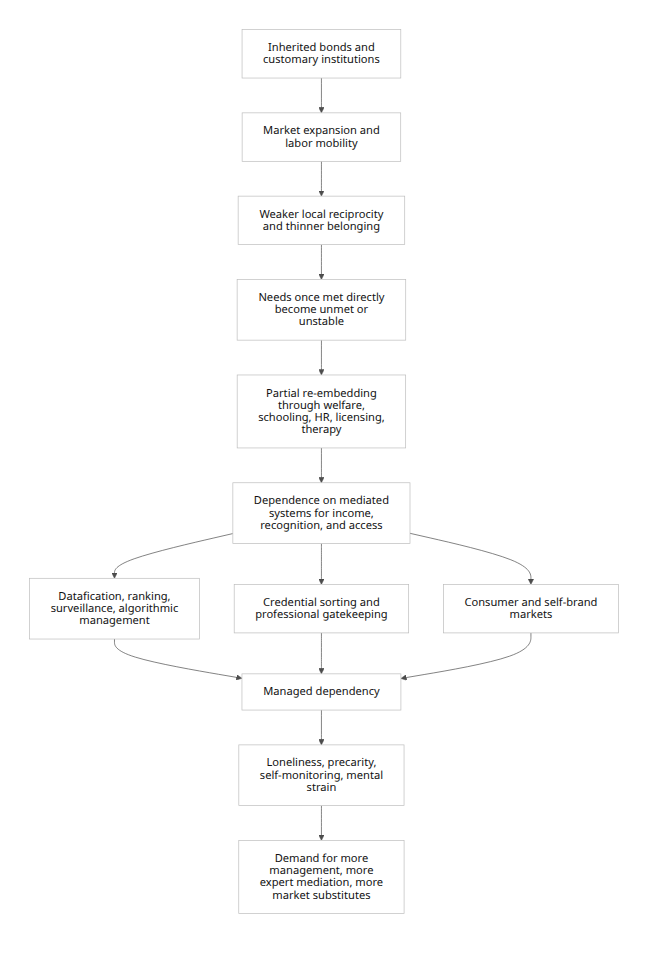
This flowchart is a synthesis of Polanyi’s disembedding thesis, Marxian commodification, Foucauldian governmentality, therapeuticization literatures, and recent OECD findings on algorithmic management and social connection. It should be read as an interpretive model, not as a single proven causal chain. \[31\]
Empirical Evidence Link to heading
The empirical record supports substantial pieces of the thesis, but unevenly. The strongest evidence concerns declining trust, weaker in-person sociality, rising loneliness salience, youth mental-health deterioration, precarious labor-market structures, and expanding forms of formalized sorting and digital surveillance. The weakest link is any attempt to show that one ideology called “liberalism” alone caused all of it. The evidence is therefore best used to evaluate the thesis as a pattern of institutional tendency rather than a singular causal law. \[32\]
Trend chart on social trust Link to heading
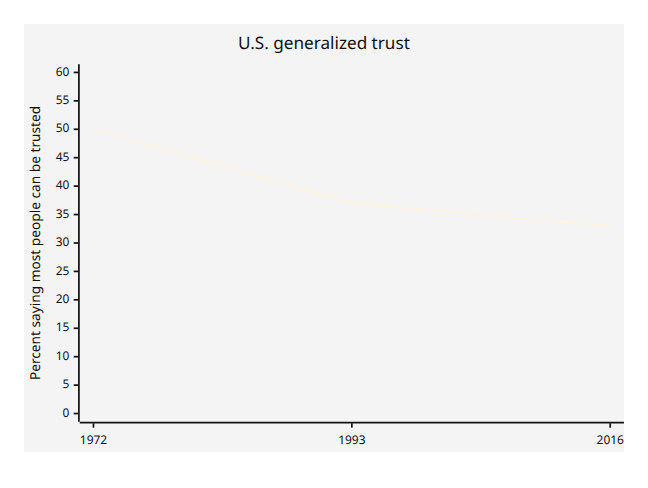
The endpoints combine NORC’s summary that half of respondents in 1972 said most people could be trusted with Putnam’s report that the same share was 37% in 1993 and about one-third by the mid-2010s. Longitudinal research using GSS data finds a substantial decline in U.S. social trust from 1973 to 2018. \[33\]
Trend chart on in-person social interaction Link to heading
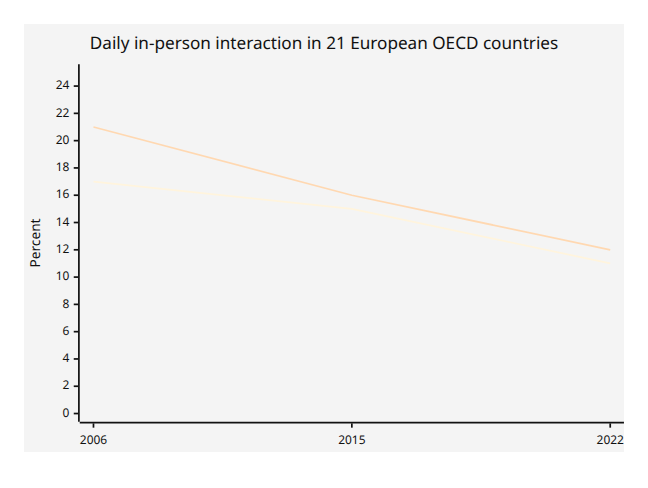
Across 21 European OECD countries, daily in-person contact with nonhousehold family fell from 17% in 2006 to 11% in 2022, while daily in-person contact with friends fell from 21% to 12%. Between 2015 and 2022, young adults saw especially sharp declines in daily in-person contact with friends. \[34\]
Trend chart on family structure Link to heading
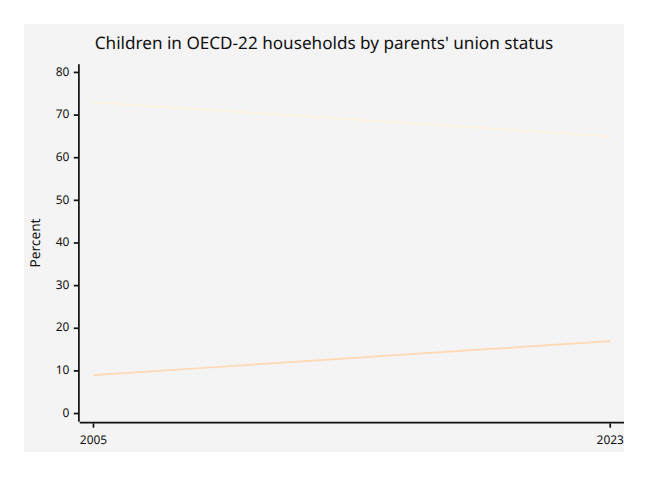
In the OECD-22 average, the share of children living with two married parents fell from 73% in 2005 to 65% in 2023, while the share living with two cohabiting parents rose from 9% to 17%. The share living with a single parent was comparatively stable on average, which means the main structural shift in the OECD average is from marriage toward cohabitation rather than only from two-parent to one-parent households. \[35\]
Trend chart on mental ill health Link to heading
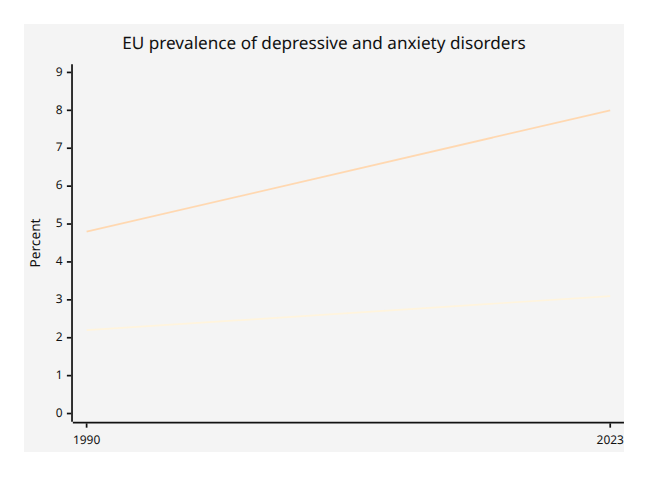
OECD analysis reports that in EU countries major depressive disorders rose from 2.2% in 1990 to 3.1% in 2023, while anxiety disorders rose from 4.8% to 8.0%. A separate OECD report on children and youth says that in 9 of 11 countries with time series data, youth mental-health status declined on average between 2012 and 2022, and that the rise in distress generally predated COVID-19. \[36\]
Selected studies and indicators Link to heading
| Study or dataset | Design and scope | Main finding | Relevance to thesis | Important caution |
|---|---|---|---|---|
| Putnam, “Bowling Alone” | Multiple U.S. time series on civic participation and trust | Volunteering, associational membership, neighborliness, and trust fell; trust declined from 58% in 1960 to 37% in 1993 | Strong evidence for erosion of civic social capital | Putnam’s causal account is debated, even when the broad trend is influential \[37\] |
| Mewes et al. | Longitudinal and repeated-cross-section GSS analysis, 1973–2018 | Individual-level factors, especially unemployment scarring and falling institutional confidence, explain about half of trust decline | Supports a link from labor insecurity and institutional erosion to atomization | Only half the decline is explained; not a monocausal result \[38\] |
| McPherson, Smith-Lovin, Brashears | GSS network module comparison, 1985 vs. 2004 | Average core discussion networks shrank; reporting no one to discuss important matters nearly tripled | Strong evidence for thinning intimate support networks | Later methodological disputes qualify magnitude, not the basic concern \[39\] |
| OECD Social Connections | Comparative OECD-European evidence, 2006–2022 | Daily in-person interaction with family and friends fell; young adults saw notable losses | Direct evidence of weaker ordinary social embeddedness | Pandemic effects overlap with longer-run shifts \[40\] |
| OECD Family Database | OECD-22 comparison, 2005–2023 | Married-parent households declined; cohabiting-parent households rose | Indicates restructuring of the household base in which solidarities are reproduced | Family change is not identical to family breakdown; some shifts reflect normative liberalization \[35\] |
| OECD youth mental-health report | OECD review of national time series | Most available series show worsening youth mental health before and during the pandemic | Supports the “managed but distressed self” component of the thesis | Reporting changes and reduced stigma may affect trend visibility \[41\] |
| WHO Commission on Social Connection | Global synthesis, 2014–2023 estimates | Roughly 1 in 6 people experience loneliness; 21% among young people; social disconnection linked to 871,000 deaths annually | Strong evidence that social fragmentation has health consequences, not only moral symbolism | Global estimates are not a direct measure of liberalism’s effects \[42\] |
| Kalleberg on precarious work | Comparative labor-market sociology | Precarious work has grown since the 1970s and contrasts with the security of the postwar decades | Supports the dependency and insecurity side of the thesis | Labor institutions differ sharply across rich democracies \[43\] |
| Kleiner and Krueger | National U.S. survey on occupational licensing | About 29% of workers required a license; licensing has wage effects roughly comparable to unions | A clear metric of credentialized gatekeeping | Not all licensing is parasitic; some protects quality and safety \[44\] |
| Blair et al. | NBER analysis of job mobility and degree requirements | Employers show an intrinsic preference for BA credentials; “degree inflation” filters out qualified workers | Strong evidence that status signals mediate access to security and advancement | Focused on the U.S.; not all degree requirements are arbitrary \[45\] |
| OECD algorithmic-management survey | 6,000 firms in six countries | 74% of surveyed managers report at least one tool to instruct, monitor, or evaluate workers | Direct evidence of managerial monetization and datafication | Measures managers’ reports, not always workers’ experience \[46\] |
Taken together, the best empirical case is cumulative. It is not that every indicator points in exactly the same direction. It is that several otherwise separate literatures—social trust, social connection, family structure, labor precarity, credential sorting, and mental-health deterioration—are all consistent with a broader picture in which social reproduction grows more mediated, more unstable, and more dependent on systems outside face-to-face community. \[47\]
Normative Comparison and Policy Implications Link to heading
The most careful comparison with fascism and communism treats them as different ways of subordinating human beings, not as moral equivalents. Fascism’s core mechanism was open domination through dictatorship, militarization, racial hierarchy, and exterminatory violence. The Holocaust was systematic, state-sponsored persecution and murder, culminating in the “Final Solution” and killing centers built for mass murder. Stalinist and Maoist communist episodes, in turn, were marked by one-party rule, show trials, purges, coercive campaigns, persecution, and catastrophic upheavals; Britannica’s summaries of the Great Purge and the Cultural Revolution capture the political terror and mass persecution dimensions, even if the full causal and quantitative literature is far larger than can be fully reviewed here. \[48\]
Liberalism’s distinct pathology is not usually annihilation but procedural extraction. It governs through contracts, labor markets, property, credentials, administrative expertise, and platforms. Its violence is generally lower in intensity and less spectacular, but its harms can be chronic: atomization, dependency, loneliness, degraded civic trust, bureaucratic opacity, therapeutic self-blame, and continuous sorting by market or credential signal. This makes it analytically plausible to speak of a distinct liberal failure mode, but misleading to collapse that mode into the categories of genocide or totalitarian terror. \[49\]
Harm categories compared Link to heading
| Category | Liberal failure mode | Fascism | Communist authoritarian episodes |
|---|---|---|---|
| Signature coercion | Diffuse market and administrative coercion; dependence on systems for work, care, housing, status | Overt dictatorship, war mobilization, racial domination | One-party command, purges, campaign politics, political terror |
| Extermination | Not constitutive and generally not central to liberal orders | Central in Nazism, above all in the Holocaust and Final Solution | Not constitutive to communist theory as such, but several regimes carried out mass repression and lethal campaigns |
| Atomization | High in the critical literature; traditional ties weaken and are replaced by mediated systems | Ambivalent: fascism destroys plural civil society but simulates organic unity | High in another sense: autonomous associations are absorbed by the party-state |
| Dependency | Dependence on wages, credentials, experts, welfare and markets after disembedding | Dependence on militarized state and leader principle | Dependence on party-state allocation and surveillance |
| Managerial monetization | Very high: needs and identities are translated into services, credentials, data, and markets | Secondary to domination and war | Bureaucratic management high; monetization lower or differently structured |
| Typical temporality | Chronic, normalized, procedural, often low-visibility | Acute, spectacular, openly violent | Campaign-driven and coercive, often episodic but intense |
This table is an analytical ideal-typical comparison synthesized from the cited literatures. It is most useful for distinguishing modes of domination, not for ranking all historical suffering on a single scale. \[50\]
Countermeasures Link to heading
If the thesis is even partly correct, the remedy is not simply “more state” or “more market.” It is re-embedding without authoritarian closure. The practical agenda suggested by the literature includes stronger labor-market security and bargaining institutions to reduce precarious dependence; family policy that lowers the cost of childrearing and stabilizes time for care; reforms of housing affordability; and public investment in civic and social infrastructure that supports face-to-face interaction rather than assuming all deficits can be solved by individualized service purchase. OECD work on fertility, family policy, platform-work regulation, and social connection all point in that direction, as does WHO’s framing of social connection as a public-health issue. \[51\]
A second cluster of reforms would target mediated dependency itself: scrutinize and roll back excessive occupational licensing; move toward skills-based hiring where possible; regulate algorithmic management for transparency, contestability, and health protections; and extend social protection and bargaining rights in platform-mediated work. The relevant literature does not imply abolishing professions or software, but it does imply putting them back in service of human capabilities rather than allowing them to become autonomous extraction and sorting systems. \[52\]
A third cluster concerns therapeutic and educational institutions. The evidence on worsening youth mental health and loneliness suggests that counseling and treatment matter, but are insufficient if social disconnection, housing stress, labor uncertainty, and digital self-commodification remain untouched. The likely lesson is “social treatment” alongside clinical treatment: more stable routines, noncommercial third places, peer association, and less pressure to turn identity into a portfolio. \[53\]
Further reading Link to heading
For a compact but serious reading list, the most useful starting points are Walzer’s “The Communitarian Critique of Liberalism”; Taylor’s “Atomism”; Polanyi’s The Great Transformation; Marx’s Capital, Volume I, especially the chapters on commodities and labor-power; Foucault’s The Birth of Biopolitics; Putnam’s “Bowling Alone”; Bourdieu’s “The Forms of Capital”; Chetty and coauthors’ “Social Capital I”; Illouz’s Saving the Modern Soul and Cold Intimacies; Kalleberg’s work on precarious labor; and recent OECD reports on social connection, family change, mental health, platform work, and algorithmic management. \[54\]
Open questions and limitations Link to heading
This report leaves several questions open. The first is causal identification: many trends consistent with the thesis are also driven by digitization, aging, suburban form, schooling expansion, and postindustrial restructuring. The second is normative heterogeneity inside liberalism itself: civil-libertarian, social-liberal, and neoliberal variants do not behave identically. The third is measurement: social capital, loneliness, and family stability are all difficult to operationalize without flattening morally complex realities. The fourth is comparative scope: the OECD-focused evidence is strongest for rich democracies, while the most violent communist and fascist cases are historically exceptional regimes rather than ordinary liberal democracies. Those limitations do not refute the thesis, but they do mean the strongest academic conclusion is a qualified one: liberalism has a distinctive extractive-managerial failure mode, yet that claim is best defended as a historically recurrent tendency rather than as a total theory of modern decline. \[55\]
\[1\] \[6\] \[18\] \[49\] \[50\] \[54\] https://www.ias.edu/sites/default/files/sss/pdfs/Walzer/CommunitarianCritiqueLiberalism.pdf
https://www.ias.edu/sites/default/files/sss/pdfs/Walzer/CommunitarianCritiqueLiberalism.pdf
\[2\] \[8\] \[10\] \[14\] https://oll.libertyfund.org/titles/robson-the-collected-works-of-john-stuart-mill-volume-xviii-essays-on-politics-and-society-part-i
\[3\] \[33\] https://gss.norc.org/content/dam/gss/for-survey-participants/documents/GSS%20Media%20Booklet_2020.pdf
\[4\] \[22\] \[37\] https://www.cftompkins.org/wp-content/uploads/2012/07/Putnam-article.pdf
https://www.cftompkins.org/wp-content/uploads/2012/07/Putnam-article.pdf
\[5\] \[48\] https://encyclopedia.ushmm.org/content/en/article/introduction-to-the-holocaust
https://encyclopedia.ushmm.org/content/en/article/introduction-to-the-holocaust
\[7\] \[34\] \[40\] https://www.oecd.org/content/dam/oecd/en/publications/reports/2025/10/social-connections-and-loneliness-in-oecd-countries_d6404192/6df2d6a0-en.pdf
\[9\] \[32\] \[38\] \[47\] \[55\] https://www.sciencedirect.com/science/article/pii/S0049089X21000144
https://www.sciencedirect.com/science/article/pii/S0049089X21000144
\[11\] \[12\] \[16\] \[19\] \[25\] \[31\] https://www.inctpped.org/spiderweb/pdf_4/Great_Transformation.pdf
https://www.inctpped.org/spiderweb/pdf_4/Great_Transformation.pdf
\[13\] \[17\] \[21\] \[24\] https://scispace.com/pdf/michel-foucault-s-the-birth-of-biopolitics-and-contemporary-etfla6wki6.pdf
https://scispace.com/pdf/michel-foucault-s-the-birth-of-biopolitics-and-contemporary-etfla6wki6.pdf
\[15\] \[20\] \[23\] https://www.marxists.org/archive/marx/works/1867-c1/ch06.htm
https://www.marxists.org/archive/marx/works/1867-c1/ch06.htm
\[26\] \[46\] https://www.oecd.org/content/dam/oecd/en/publications/reports/2025/02/algorithmic-management-in-the-workplace_3c84ed6d/287c13c4-en.pdf
\[27\] https://www.ucpress.edu/books/saving-the-modern-soul/pdf
https://www.ucpress.edu/books/saving-the-modern-soul/pdf
\[28\] \[45\] https://www.nber.org/system/files/working_papers/w28991/revisions/w28991.rev0.pdf
https://www.nber.org/system/files/working_papers/w28991/revisions/w28991.rev0.pdf
\[29\] https://www.oecd.org/en/publications/regulating-platform-work-in-the-digital-age_181f8a7f-en.html
https://www.oecd.org/en/publications/regulating-platform-work-in-the-digital-age_181f8a7f-en.html
\[30\] https://journals.sagepub.com/doi/10.1177/2056305118784768
https://journals.sagepub.com/doi/10.1177/2056305118784768
\[35\] https://webfs.oecd.org/els-com/Family_Database/SF_1_2_Children_in_families.pdf
https://webfs.oecd.org/els-com/Family_Database/SF_1_2_Children_in_families.pdf
\[36\] https://www.oecd.org/en/publications/the-economic-case-for-preventing-mental-ill-health_16668f16-en/full-report/trends-and-patterns-in-mental-ill-health_43f77277.html
\[39\] https://www.researchgate.net/publication/237264578_Social_Isolation_in_America_Changes_in_Core_Discussion_Networks_Over_Two_Decades
\[41\] \[53\] https://www.oecd.org/en/publications/child-adolescent-and-youth-mental-health-in-the-21st-century_1092c3cb-en/full-report/trends-and-patterns-in-the-mental-health-status-of-children-adolescents-and-young-people_696bf3a0.html
\[42\] https://www.who.int/news/item/30-06-2025-social-connection-linked-to-improved-heath-and-reduced-risk-of-early-death
\[43\] https://www.asanet.org/wp-content/uploads/sage_kalleberg_presidential_address.pdf
https://www.asanet.org/wp-content/uploads/sage_kalleberg_presidential_address.pdf
\[44\] \[52\] https://www.nber.org/system/files/working_papers/w14308/w14308.pdf
https://www.nber.org/system/files/working_papers/w14308/w14308.pdf
\[51\] https://www.oecd.org/content/dam/oecd/en/publications/reports/2024/06/society-at-a-glance-2024_08001b73/918d8db3-en.pdf