Executive summary Link to heading
The hypothesis can be proven in a qualified historical and analytical sense. Modern progressive politics is not identical to Marxism, and many of its contemporary forms are openly non-Marxist or post-Marxist. But the connection is still strong, traceable, and non-accidental. The best way to formalize it is to say that a substantial part of modern progressive politics is a mediated descendant of Marxist and Marx-adjacent socialist traditions: first through labor movements and social democratic parties, then through welfare-state institution building, then through Western Marxism, socialist feminism, anti-colonial left politics, and labor-linked policy networks. In that sense, the relationship is one of genealogical inheritance plus selective adaptation, not one of simple identity. \[1\]
The strongest evidence appears where five things overlap: a class-centered critique of capitalism; organizational continuity between unions, socialist parties, and progressive movements; programmatic continuity in redistribution, labor rights, public services, and public ownership; rhetorical continuity centered on inequality, exploitation, oligarchy, monopoly, and social rights; and intellectual continuity through social-democratic, Marxist, critical-theory, and socialist-feminist networks. Where three or more of those mechanisms are present together, the connection is no longer a loose resemblance but a historically grounded lineage. That threshold is clearly met in the German SPD, British Labour, Swedish social democracy, the U.S. democratic-socialist/progressive bloc around DSA and the Congressional Progressive Caucus, Brazil’s PT, Chile’s left coalitions, and India’s CPI(M)-linked state-level left governance. \[2\]
The strongest substantive continuities are found in welfare-state politics, labor law, health care, education, progressive taxation, corporate regulation, public planning, and public ownership or quasi-public control. Comparative political economy literature long ago showed that welfare-state development was deeply tied to organized labor and left parties, not merely to abstract national culture. Korpi’s power-resources framework and Esping-Andersen’s decommodification framework remain the most useful academic bridges between Marxian class theory and modern progressive policymaking. OECD data still show the scale of the institutional residue: public social spending averages about one-fifth of GDP across the OECD, while union density and bargaining coverage remain much higher in classic social-democratic settings such as Sweden than in market-liberal systems such as the United States. \[3\]
The connection becomes more complex in the areas of identity politics, environmentalism, and NGO/think-tank activism. Here the line of descent is real but less direct. Black feminism, intersectionality, and recognition-based politics did not simply “come from Marxism,” but many of their most influential formulations emerged in dialogue with socialist feminism, anti-capitalist politics, and Western Marxist critiques of domination. Likewise, today’s climate-progressive agenda often fuses ecological concerns with labor rights, industrial planning, anti-monopoly politics, and public investment, as seen in the Green New Deal. These are recognizably post-Keynesian, social-democratic, and eco-socialist adaptations of older socialist repertoires rather than straightforward repetitions of nineteenth-century Marxism. \[4\]
The central conclusion, therefore, is this: modern progressive politics is best understood neither as a disguised form of pure Marxism nor as wholly independent of Marxism. It is better understood as a broad political family in which some branches are directly Marxist, some are social-democratic revisions of Marxism, some are liberal-left formations heavily shaped by socialist institutions, and some are hybrid movements that adopted Marxist categories without preserving Marxist end goals. The continuity is strongest at the levels of institutions, political economy, labor organization, and structural rhetoric, and weakest where progressive politics shifted toward pluralist recognition claims, civil-rights constitutionalism, and non-class social-movement agendas. \[5\]
Thesis, definitions, and method Link to heading
The thesis of this report is deliberately precise: there is a formalizable connection between modern progressive politics and Marxism because contemporary progressive politics inherits, translates, and selectively revises core Marxist and socialist ideas through identifiable historical mechanisms. “Formalizable” here means that the relationship can be stated as a testable argument rather than a cultural impression. The argument is strongest if one defines the connection not as complete doctrinal sameness, but as a pattern of durable transmission across texts, organizations, personnel, policy programs, and intellectual networks. If “proof” means mathematical necessity, no historical question can be proven that way. If it means demonstrating a robust causal-genealogical relationship with enough direct and indirect evidence to make alternative explanations less convincing, then the hypothesis is supported. \[6\]
For purposes of this report, Marxism means the tradition stemming from Marx and Engels that centers historical materialism, class struggle, exploitation under wage labor, the concentration and contradictions of capital, and the possibility of transcending capitalism through social ownership or associated control over production. The Communist Manifesto supplied the canonical language of bourgeois society and class conflict; the Critique of the Gotha Programme elaborated the transitional logic of socialism and communism; and modern philosophical summaries still treat class, exploitation, alienation, and historical change as the load-bearing concepts of the tradition. \[7\]
For purposes of this report, modern progressive politics means the contemporary cluster of center-left and left politics organized around some combination of redistribution, universal or near-universal social rights, labor protection, anti-discrimination, civil liberties, feminism, racial justice, environmental sustainability, economic regulation, and suspicion of concentrated private power. The Congressional Progressive Caucus defines itself in terms of prioritizing working people over corporate interests and supporting universal health care, debt-free college, climate action, immigration reform, and social equality. Comparable coalitions in Europe and Latin America articulate similar bundles in the language of social justice, anti-neoliberalism, state responsibility for rights, and inclusive democracy. \[8\]
The key analytical move is to distinguish descent from convergence. Some progressive policies could arise without Marxism; universal schooling, anti-poverty policy, and civil-rights reform also have liberal, Christian-social, republican, feminist, and anti-colonial lineages. A rigorous method therefore asks not whether progressives ever support policies Marxists also support, but whether the relationship is historically structured. The method used here combines conceptual genealogy, comparative process tracing, and institutional analysis. In practice, that means looking for five evidentiary markers: explicit textual borrowing; organizational continuity; personnel circulation; policy translation from socialist ideas into reformist law; and stable rhetorical frames around class power, domination, and social rights. \[9\]
A useful methodological control is to ask what would count against the hypothesis. The hypothesis would weaken if modern progressivism consistently emerged in settings without labor-socialist institutions, without left-class rhetoric, without unions, and without socialist intellectual mediation. It would also weaken if the major progressive parties explicitly rejected all socialist inheritance while pursuing purely market-liberal egalitarianism. The evidence instead shows the opposite: even where parties revised or moderated Marxism, they generally did so from inside labor and socialist traditions rather than from outside them. The SPD’s current Hamburg Programme still says the party draws from “Marxist analysis of society” alongside Judaism, Christianity, Humanism, the Enlightenment, the women’s movement, and new social movements. That sentence is unusually valuable because it states both continuity and pluralization at once. \[10\]
The geographic scope here is global but weighted toward the United States, the United Kingdom, Western Europe, Latin America, and India, as requested. The underlying evidence base is uneven. Western European party archives and OECD labor/welfare data are strong; U.S. movement sources are abundant but ideologically diffuse; Latin American and Indian official materials are plentiful but often multilingual and less standardized; and there is no single global dataset that directly measures “Marxist influence” on modern progressive politics. Where evidence is thinner, this report flags the limitation rather than pretending there is a precision that does not exist. \[11\]
Mechanisms of transmission Link to heading
The first mechanism is ideological inheritance. Social democracy and democratic socialism emerged historically as revisions of Marxist strategy, not as unrelated traditions. Przeworski’s classic formulation was that socialist movements confronted the choice of contesting elections, broadening beyond the working class, and reforming rather than abolishing capitalism; those decisions produced mass reformist labor parties rather than revolutionary parties. The SPD’s own history page explicitly describes the 1959 Godesberg Program as a turning point away from an allegedly inevitable development toward socialism and toward reform-oriented democratic socialism, while the current Hamburg Programme says the party remains rooted in the labor movement and in Marxist social analysis. The result is not “Marxism unchanged,” but Marxism translated into parliamentary social democracy. \[12\]
The second mechanism is policy translation. Marxism in government rarely survives as pure abolitionist doctrine inside democratic systems. It reappears as policies that decommodify essential goods, subordinate markets to collective goals, and reduce employers’ discretionary power. Korpi’s power-resources approach ties welfare-state development to class conflict and the organizational strength of labor. Esping-Andersen’s famous language of decommodification likewise describes welfare institutions that reduce dependence on pure market income. OECD data show how enduring those translated institutions became: public social spending averages around 21% of GDP across the OECD, and in the highest-spending cases exceeds 30% of GDP. The modern progressive commitment to universal health care, public education, social insurance, labor standards, and state-led industrial transition is best understood as the reformist policy form of older socialist and labor demands. \[13\]
The third mechanism is organizational influence. Where progressive parties are structurally linked to unions, the historical connection to Marxism and socialism is especially visible. Labour’s own website says the party was formed out of the trade union movement to give working people a political voice. The Swedish Social Democratic Party’s program describes the labor movement as developing along union and political lines in natural cooperation. The SPD states that it developed as part of the labor movement and worked “together with the trade unions” to build workers’ rights and the welfare state. OECD data show that the organizational foundation remains far stronger in social-democratic systems than in liberal ones: union density is 65.9% in Sweden, 22% in the UK, 14.1% in Germany, and 9.9% in the United States, while bargaining coverage remains 88% in Sweden, 49% in Germany, 40.2% in the UK, and only 11.1% in the U.S. \[14\]
The fourth mechanism is rhetorical continuity. Modern progressive rhetoric frequently preserves socialist and Marxian patterns even when it drops revolutionary language. The CPC says it prioritizes working Americans over corporate interests; DSA says it rejects an order based on private profit, alienated labor, and gross inequalities of wealth and power; Sanders’ issue and press materials frame politics around billionaires, oligarchy, and working families; the Green New Deal resolution links climate action to union jobs, monopoly power, rights, and economic security; PT’s statute defines the party as fighting to eliminate exploitation, domination, oppression, inequality, injustice, and misery in order to build democratic socialism; Boric’s coalition program says the market should cease being society’s structuring principle and the state should resume a primary role in guaranteeing social rights and administering natural resources. These are not random shared metaphors. They are a recurring anti-domination lexicon whose deepest twentieth-century carriers were Marxist, socialist, and labor traditions. \[15\]
The fifth mechanism is intellectual-network transmission. Western Marxism and critical theory widened the socialist critique from factory exploitation alone to culture, legitimacy, ideology, and forms of domination that were not exhausted by wage relations. The Stanford Encyclopedia’s critical-theory entry explicitly places the Frankfurt School inside the Western European Marxist tradition. Black feminism and intersectional theory then extended anti-domination analysis in a different direction. The Combahee River Collective defined its politics as opposed to racial, sexual, heterosexual, and class oppression, embraced identity politics, and declared itself socialist because work should serve the collective benefit of those who do it rather than the profit of bosses. Crenshaw’s foundational article on intersectionality did not arise as orthodox Marxism, but it emerged from a radical Black feminist critique of the limits of single-axis analysis. Fraser later diagnosed a “post-socialist” shift from redistribution toward recognition. The line of descent here is real but mediated: modern progressive identity politics is not reducible to Marxism, yet major parts of its most influential theory developed in ongoing argument with socialist-feminist and Marxist categories. \[16\]
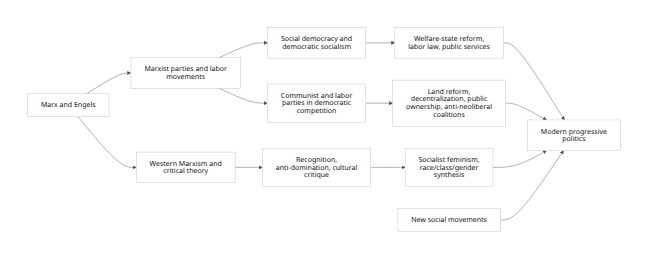
The flow chart captures the main conclusion of the mechanism section: the path from Marxism to modern progressivism is usually indirect and cumulative, not linear. Social democracy, democratic socialism, the New Left, socialist feminism, labor institutions, and anti-neoliberal coalitions act as transmission belts. That is why the strongest “proof” is rarely a single manifesto line; it is the combination of party genealogy, union linkage, policy inheritance, and adapted rhetoric across time. \[17\]
Comparative case studies Link to heading
The comparative evidence is strongest when examined through real parties, movements, policies, and personnel across time. The table below compresses the highest-confidence cases.
| Case | Marxist or socialist inheritance | Organizational bridge | Illustrative policies and rhetoric | Continuity judgment |
|---|---|---|---|---|
| Germany SPD | Hamburg Programme says SPD draws on “Marxist analysis of society”; party history page says Godesberg redefined democratic socialism from inevitabilist socialism to reform practice. | SPD describes itself as part of the labor movement and says it developed the welfare state together with trade unions. | Workers’ rights, welfare state, reformist democratic socialism, later incorporation of women’s and new social movements. | Strong but revised |
| United Kingdom Labour | Labour official site says the party was formed out of the trade union movement; historic Labour politics included common-ownership traditions and postwar nationalization. | Affiliated unions remain a structural part of party life. | NHS creation in 1948; Bank of England nationalization in 1946; labor-rights link persists. | Strong in origin, moderated in doctrine |
| Sweden SAP and LO | Swedish party program locates the movement in union-political cooperation; wage-earner funds were proposed for “economic democracy.” | Dense union-party cooperation through the labor movement. | Universalistic welfare state, solidaristic wage setting, Meidner funds to counter concentrated capital ownership. | Very strong institutional continuity |
| United States DSA, Sanders, CPC | DSA rejects private-profit order and unequal wealth-power structures; Sanders and the CPC frame politics as workers vs corporations and billionaires. | Electoral coalitions, DSA chapters, nurses’ unions, labor-backed issue campaigns. | Medicare for All, wealth tax, Green New Deal, right to organize, debt-free college, anti-monopoly language. | Strong in factions, not hegemonic in the whole center-left |
| Brazil PT and CUT | PT statute defines mission as building democratic socialism and eliminating exploitation and oppression. | Labor-party nexus developed with CUT and later mass social coalitions. | Bolsa Família, participatory budgeting, labor rights, anti-poverty institutions, rights-based developmentalism. | Strong origin, moderated governing form |
| Chile Frente Amplio and Apruebo Dignidad | Boric coalition program says market should cease structuring society; coalition included the Communist Party and anti-neoliberal left currents. | Coalition between Broad Front parties, Communist Party, student-movement cadres, and a joint policy observatory. | Feminism, ecological transition, social rights, stronger state role, labor reform, public-resource administration. | Strong anti-neoliberal continuity, plural ideological mix |
| India CPI(M) and Kerala left governance | CPI(M) explicitly seeks socialism via people’s democracy and combines parliamentary and extra-parliamentary struggle. | Party-linked mass organizations and state-level left governance. | Land reform, decentralization, panchayat strengthening, pro-people policy, strong health outcomes in Kerala. | Direct Marxist continuity with democratic-state adaptation |
Sources for the table: Germany: Hamburg Programme and SPD history. \[10\] United Kingdom: Labour affiliated unions page; NHS and Bank of England official sources. \[18\] Sweden: SAP program, party constitution, and wage-earner funds literature. \[19\] United States: DSA constitution, CPC official pages, Green New Deal text, Sanders and Medicare for All materials. \[20\] Brazil: PT statute and principles, plus PT transformation literature and Bolsa Família evidence. \[21\] Chile: Frente Amplio principles, Apruebo Dignidad program, coalition statement, and academic work on Chile’s renewed left. \[22\] India: CPI(M) programme and Kerala official health dashboard. \[23\]
Germany is the clearest European example of continuity through revision. The SPD’s current Hamburg Programme explicitly says that since Godesberg the party has seen itself as the people’s party of the left with roots in Judaism, Christianity, Humanism, Enlightenment, Marxist social analysis, and labor-movement experience. That formulation is exceptionally revealing. It does not deny Marxist inheritance; it domesticates it inside a pluralist democratic left. The SPD’s own history page likewise says the 1959 Godesberg Program moved the party away from the notion of an inevitable historical transition to socialism and toward acceptance of private property where it serves the common good. The connection to modern progressivism is therefore not that the SPD stayed purely Marxist; it is that one of the core templates for today’s progressive center-left was built by revising Marxism from within. \[10\]
The British Labour case shows the same pattern in a more institutionally union-centered form. Labour’s official site still says the party was formed out of the trade union movement to give working people their own political voice. Once in office, Labour translated socialist and labor demands into concrete state-building: the Bank of England Act 1946 placed the central bank in public ownership and public control, while Britain’s NHS formally opened on 5 July 1948 as a universal public health institution. Even if later Labour governments moved toward market-friendly social democracy or Third Way moderation, the foundational link between trade unions, democratic socialism, and public-service universalism remained one of the most decisive channels through which Marxism-adjacent politics entered mainstream progressive governance. \[24\]
Sweden is the strongest case of institutionalized class compromise with socialist roots. The SAP’s program says the Swedish labor movement grew along trade-union and political lines whose cooperation “was, and is, natural.” That is already enough to mark modern Swedish progressivism as inseparable from organized labor. The more radical edge appeared in Rudolf Meidner’s wage-earner funds, proposed through the LO and defended as a means of developing “economic democracy,” countering concentrated ownership, and building collective capital. Even though the final implementation was watered down, the episode is analytically important: one of the most admired progressive welfare states in the world did not merely regulate capitalism; at moments it explored mechanisms for socializing ownership itself. That is a direct line from Marxist concerns with capital concentration to reformist progressive experiments. \[25\]
The U.S. case is more fragmented, but it is still powerful. DSA’s constitution says it rejects an order based on private profit, alienated labor, and gross inequalities of wealth and power. The CPC says it prioritizes working Americans over corporate interests and supports universal health care, debt-free college, climate action, and economic equality. The Green New Deal resolution linked climate policy to a ten-year national mobilization, high-quality union jobs, job guarantees, higher education, the right to organize, health care, housing, and freedom from monopoly domination. Jayapal, Dingell, and Sanders introduced Medicare for All in 2023 with more than half of the Democratic caucus cosponsoring the House bill, and Sanders later proposed a 5% annual wealth tax on 938 billionaires, framed as a means of funding direct payments and expanded Medicare benefits. The U.S. progressive left therefore supplies strong evidence of policy translation and rhetoric, even if the Democratic Party as a whole is not socialist. \[26\]
Brazil’s PT shows how a labor-socialist formation can be moderated by electoral and governing pressures without losing the underlying lineage. PT’s official structure page quotes Article 1 of the party statute, defining the party as a voluntary association committed to democracy, solidarity, and transformations oriented toward eliminating exploitation, domination, oppression, inequality, injustice, and misery, with the goal of constructing democratic socialism. The party’s foundational principles predate formal party creation and explicitly invoke a workers’ party. Samuels and Hunter both describe the PT as having moved from a more openly socialist identity toward social-democratic or centrist governing forms, but they also emphasize that this was a transformation of a left mass party, not its replacement by a non-socialist formation. On the policy side, Bolsa Família became one of the world’s most influential anti-poverty programs, while participatory budgeting in Porto Alegre became a hallmark of democratic deepening associated with the Brazilian left. Those policies are not “Marxist” in a doctrinaire sense, but they are legible as reformist descendants of socialist commitments to redistribution, participation, and labor-centered citizenship. \[27\]
Chile demonstrates how modern progressive politics can arise from a synthesis of student movements, democratic socialism, environmentalism, feminism, and explicit communist alliance. Frente Amplio’s principles and Apruebo Dignidad’s government program were explicit about justice, anti-neoliberalism, ecological transition, and a stronger state role. The program said the market should stop functioning as the structuring principle of society and the state should regain a leading role in guaranteeing social rights and administering natural resources. Apruebo Dignidad also formally linked the Broad Front with the Communist Party of Chile and created a joint policy observatory involving research centers from both currents. Academic accounts of Chile’s recent left stress that part of the new left grew out of student mobilization while also converging with the Communist Party and older left strands. This is important because it shows both continuity and mutation: contemporary Chilean progressivism is broader than Marxism, but in one of its most consequential governing coalitions the Marxist connection is not hidden at all. \[28\]
India’s CPI(M) and the Kerala model show the clearest case of direct Marxist vocabulary coexisting with democratic adaptation. The CPI(M) programme explicitly says the party aims to guide workers, peasants, and progressive democratic forces toward people’s democracy as a step toward socialism, and it says communist and left-led governments in Kerala, West Bengal, and Tripura showed the way through land reform, decentralization, revitalization of panchayats, and democratic rights. The same program explicitly endorses combining parliamentary and extra-parliamentary struggle and pursuing socialist transformation through peaceful means where possible. In Kerala, the official health dashboard reports an IMR of 5 in 2023 and life expectancy of 75.1 years in 2019–23, the highest in India. The inferential point is not that every positive social indicator in Kerala is “caused by Marxism,” but that one of the world’s most durable democratic-communist governing traditions translated class politics into decentralized, public-service-heavy, pro-people statecraft with measurable outcomes. \[23\]
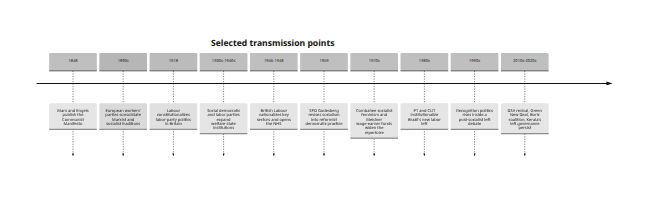
The timeline matters because it reveals the structure of continuity. Marxism’s influence on modern progressivism did not travel in a straight line from 1848 to the present. It moved through workers’ parties, social democracy, welfare-state statecraft, critical theory, socialist feminism, anti-neoliberal coalitions, and democratic-socialist revival. That is why countries and parties can look very different in doctrinal terms while still sharing a common lineage. \[29\]
Quantitative patterns, continuities, and divergences Link to heading
The strongest quantifiable evidence of continuity lies in the institutional infrastructure of class politics. Union density and bargaining coverage remain far higher where labor movements historically built social-democratic settlements than where progressivism developed inside a market-liberal setting. This does not “prove Marxism” by itself, but it shows the durability of the organizational terrain through which Marxist and socialist ideas were historically translated into mainstream progressive politics. \[30\]
| Country | Union density | Adjusted bargaining coverage | What the numbers suggest |
|---|---|---|---|
| Sweden | 65.9% | 88% | Progressive politics rests on dense labor-market institutions and sectoral bargaining. |
| United Kingdom | 22% | 40.2% | The labor link remains significant but far weaker than in classic Nordic social democracy. |
| Germany | 14.1% | 49% | Union membership is lower, but bargaining institutions still preserve a labor-social compromise. |
| United States | 9.9% | 11.1% | Progressive politics exists, but class organization is much thinner and more factionalized. |
Source note: OECD/AIAS ICTWSS 2024 country notes for Sweden, the UK, Germany, and the U.S. \[30\]
Voting research reinforces the same point. Arndt and colleagues describe social democratic parties and unions as originating in the same movement, with unions acting as the economic arm and parties as the political arm of labor. Freeman’s NBER paper found that union members in the United States were more likely to vote Democratic than demographically comparable nonunion voters. More recent work on Europe finds that unions still help translate redistributive preferences into left voting even amid immigration and cultural conflict. These are measurable traces of the same underlying mechanism: organizational labor power has historically carried Marxian and socialist concerns into electoral progressive politics even where party ideologies later moderated. \[31\]
Policy adoption also shows patterned rather than accidental continuity. The Green New Deal resolution tied decarbonization to public investment, union jobs, participatory planning, anti-monopoly commercial rules, and universal access to health care, housing, and education. The CPC claims more than 100 members. Medicare for All in 2023 was introduced with more than half of the Democratic caucus as House cosponsors. Sanders’ 2026 wealth-tax bill targeted 938 billionaires and was framed as a direct counter to concentrated private wealth. Those particulars matter because they show contemporary progressivism repeatedly reaching for policy forms long associated with socialist traditions: decommodification, industrial planning, labor empowerment, and redistribution from capital to social use. \[32\]
The welfare state is perhaps the broadest long-run residue of the connection. The OECD’s social-spending dashboard reports that public social spending averages about 21% of GDP across OECD countries, with some high-spending states exceeding 30% of GDP. Korpi’s power-resources theory and Esping-Andersen’s decommodification framework explain why this matters: welfare states are not just administrative conveniences; they are historically sedimented outcomes of class organization, left-party competition, and institutionalized attempts to reduce workers’ dependence on unfettered labor markets. That is why modern progressive demands for universal childcare, public health insurance, paid leave, public pensions, and labor-market regulation are analytically closer to social democracy and reformist Marxian politics than to classical laissez-faire liberalism. \[33\]
The deepest continuity is in political economy. Marxism’s central concern was not simply that poverty exists, but that capitalism gives structurally disproportionate power to owners of capital. Modern progressive politics still centers that concern, even when it no longer calls for full abolition of capitalism. Progressive rhetoric against billionaires, monopoly domination, corporate power, landlord extraction, and privatization is recognizably downstream from Marxist and socialist critiques of ownership and class rule. PT’s statute speaks of exploitation and domination; DSA rejects private-profit social order; CPC frames corporate interests against working people; the Green New Deal names monopoly domination; CPI(M) still speaks openly of monopoly capitalism, landlordism, and socialist transformation; and Boric’s program seeks to displace the market as the organizing principle of society. This is the most important substantive proof in the report: modern progressive politics consistently recodes the Marxist problem of class power into contemporary democratic language. \[34\]
The most important divergences should be stated just as clearly. Many modern progressive actors do not seek abolition of capitalism, dictatorship of the proletariat, or comprehensive social ownership. The SPD explicitly broke with historical inevitabilism and accepted private property conditioned by the common good. Boric, in a widely read interview, distinguished moving beyond neoliberalism from declaring the immediate end of capitalism. The CPC is a caucus inside a liberal-democratic party, not a socialist party-state project. Intersectionality arose from Black feminist legal and movement critique, not from class-reductionist Marxism. Environmentalism also draws from scientific ecology, conservation, and indigenous politics, not only socialist traditions. The connection to Marxism is therefore strongest when progressivism addresses labor, redistribution, ownership, public provision, and anti-monopoly politics, and weakest where it becomes a broad liberal coalition around rights and recognition detached from class organization. \[35\]
A compact way to summarize the continuities and divergences is to map policy families by the strength of Marxist inheritance.
Policy family Strength of connection Why to Marxist lineage
Unionization and Very strong Built directly through collective bargaining labor movements and class organization.
Welfare state and Very strong Core social-democratic social insurance translation of decommodification and labor power.
Public ownership and Strong Direct descendant of democratic control socialist concern with ownership of production, though often softened.
Universal health care Strong Reformist and education institutionalization of social rights and decommodification.
Progressive taxation Strong Modern democratic form and anti-monopoly of limiting regulation concentrated capital power.
Identity politics and Moderate, mediated Developed partly intersectionality through socialist feminism and anti-capitalist critique, but not reducible to Marxism.
Environmentalism and Moderate, mediated Eco-socialist and climate justice labor-green traditions matter, but so do non-Marxist ecological lineages.
Civil-liberties and Mixed Often compatible with rights pluralism socialist politics but also deeply liberal and republican in origin. Link to heading
The academic literature supports this hierarchy. Korpi and Esping-Andersen make the strongest case for the labor–welfare-state connection; Przeworski explains the reformist electoral turn of socialist parties; Freeman and later union-voting work support the union–left linkage; critical theory, socialist feminism, Crenshaw, and Fraser explain why identity and recognition politics sit in a more mediated relationship to Marxism. Taken together, the evidence suggests that the proposition is strongest in political economy and weaker—but still real—in cultural and identity-centered domains. \[36\]
Open questions and conclusion Link to heading
Several limitations remain. There is no single cross-national database that codes “Marxist influence” in party platforms, personnel networks, funding structures, and enacted law at once. The evidence for Western Europe and the United States is better standardized than for Latin America and India. Some crucial official texts for Brazil and Chile are in Portuguese or Spanish; they are essential to the cases, but they limit perfectly even comparison with English-language archives. Quantification is strongest for union density, bargaining coverage, caucus size, and some programmatic sponsorship counts, but weaker for measuring the relative causal weight of Marxism versus liberalism, feminism, Christian democracy, anti-colonial nationalism, or green thought inside any single movement. Those are real data gaps, not fatal flaws. \[37\]
Even with those caveats, the report’s main conclusion is firm. Modern progressive politics is historically and structurally connected to Marxism. The connection is not a slogan, not a conspiracy claim, and not a claim of total equivalence. It is a historically traceable pattern in which Marxist theory, socialist party formation, labor organization, welfare-state construction, critical-theory revision, socialist-feminist expansion, and anti-neoliberal coalition politics all helped produce the repertoire now called “progressive.” The proof is strongest where official party documents, labor institutions, enacted policies, and academic research all point in the same direction, as they do in the SPD, Labour, Swedish social democracy, DSA/CPC politics, PT, Apruebo Dignidad, and CPI(M)-linked governance. \[38\]
The best final formulation is therefore this: modern progressive politics is a broad, plural, and often moderate political formation whose deepest institutional and political-economic layers are substantially indebted to Marxist and socialist traditions, even when its contemporary actors reject orthodox Marxism or define themselves more narrowly as social democrats, democratic socialists, feminists, anti-racists, greens, or progressives. The continuity is strongest in labor, welfare, redistribution, ownership, and anti-monopoly politics; the divergences are greatest on revolution, class primacy, and the end-state of capitalism; and the overall relationship is best captured as one of mediated inheritance rather than identity. On that qualified but rigorous standard, the hypothesis stands. \[39\]
\[1\] \[7\] \[29\] Manifesto of the Communist Party
https://www.marxists.org/archive/marx/works/download/pdf/Manifesto.pdf?utm_source=chatgpt.com
\[2\] \[5\] \[9\] \[10\] \[17\] \[38\] https://www.spd.de/fileadmin/Dokumente/Beschluesse/Grundsatzprogramme/hamburger_programm_englisch.pdf
\[3\] \[13\] \[36\] \[39\] https://www.cambridge.org/core/journals/world-politics/article/power-resources-and-employercentered-approaches-in-explanations-of-welfare-states-and-varieties-of-capitalism-protagonists-consenters-and-antagonists/6B7688A17F6C7EF213F0E6D2ACE7130B
\[4\] https://americanstudies.yale.edu/sites/default/files/files/Keyword%20Coalition_Readings.pdf
https://americanstudies.yale.edu/sites/default/files/files/Keyword%20Coalition_Readings.pdf
\[6\] \[12\] https://philpapers.org/rec/PRZCAS-3
https://philpapers.org/rec/PRZCAS-3
\[8\] \[15\] https://progressives.house.gov/about-the-cpc
https://progressives.house.gov/about-the-cpc
\[11\] https://www.oecd.org/en/data/datasets/social-expenditure-database-socx.html
https://www.oecd.org/en/data/datasets/social-expenditure-database-socx.html
\[14\] \[18\] \[24\] https://labour.org.uk/about-us/affiliated-unions/
https://labour.org.uk/about-us/affiliated-unions/
\[16\] https://plato.stanford.edu/entries/critical-theory/
https://plato.stanford.edu/entries/critical-theory/
\[19\] \[25\] https://library.fes.de/pdf-files/ialhi/90144/90144.pdf
https://library.fes.de/pdf-files/ialhi/90144/90144.pdf
\[20\] \[26\] https://www.dsausa.org/about-us/constitution/
https://www.dsausa.org/about-us/constitution/
\[21\] \[27\] \[34\] https://pt.org.br/estrutura-partidaria/
https://pt.org.br/estrutura-partidaria/
\[22\] \[28\] https://frenteampliochile.cl/nosotros/nuestros-principios/
https://frenteampliochile.cl/nosotros/nuestros-principios/
\[23\] https://cpim.org/party-programme/
https://cpim.org/party-programme/
\[30\] https://www.oecd.org/content/dam/oecd/en/data/datasets/oecd-aias-ictwss/Germany.pdf
https://www.oecd.org/content/dam/oecd/en/data/datasets/oecd-aias-ictwss/Germany.pdf
\[31\] https://centaur.reading.ac.uk/72615/1/Union%20members%20at%20the%20polls_submission17032016%20%281%29.pdf
\[32\] https://www.congress.gov/bill/116th-congress/house-resolution/109/text
https://www.congress.gov/bill/116th-congress/house-resolution/109/text
\[33\] https://www.oecd.org/en/data/dashboards/social-expenditure-dashboard.html
https://www.oecd.org/en/data/dashboards/social-expenditure-dashboard.html
\[35\] https://www.spd.de/programm/geschichte-der-spd-grundsatzprogramme
https://www.spd.de/programm/geschichte-der-spd-grundsatzprogramme
\[37\] https://www.oecd.org/content/dam/oecd/en/data/datasets/oecd-aias-ictwss/OECD-AIAS-ICTWSS-v2-Codebook.pdf